


Akhenaten and Moses
Did the monotheism of Egyptian Pharaoh Akhenaten influence Moses?

On this stela from El-Amarna, Egyptian King Akhenaten is seen with his wife Nefertiti and their daughters bearing offerings to the sun-disk Aten. Public domain, via Wikimedia Commons
Defying centuries of traditional worship of the Egyptian pantheon, Egyptian Pharaoh Akhenaten decreed during his reign in the mid-14th century B.C.E. that his subjects were to worship only one god: the sun-disk Aten. Akhenaten is sometimes called the world’s first monotheist. Did his monotheism later influence Moses—and the birth of Israelite monotheism?
In “Did Akhenaten’s Monotheism Influence Moses?” in the July/August 2015 issue of Biblical Archaeology Review, University of California, Santa Barbara, emeritus professor of anthropology Brian Fagan discusses this tantalizing question.
Egyptian King Akhenaten, meaning “Effective for Aten”—his name was originally Amenhotep IV, reigned from about 1352 to 1336 B.C.E. In the fifth year of his reign, he moved the royal residence from Thebes to a new site in Middle Egypt, Akhetaten (“the horizon of Aten,” present-day Tell el-Amarna), and there ordered lavish temples to be built for Aten. Akhenaten claimed to be the only one who had access to Aten, thus making an interceding priesthood unnecessary.
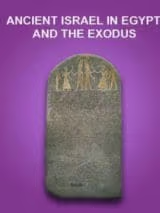
In the BAR article “The Monotheism of the Heretic Pharaoh,” Donald B. Redford, who excavated Akhenaten’s earliest temple at Karnak (in modern Thebes), describes how Akhenaten instituted worship of Aten:
The cult of the Sun-Disk emerged from an iconoclastic “war” between the “Good God” (Akhenaten), and all the rest of the gods. The outcome of this “war” was the exaltation of the former and the annihilation of the latter. Akhenaten taxed and gradually closed the temples of the other gods; the images of their erstwhile occupants were occasionally destroyed. Cult, ritual and mythology were anathematized, literature edited to remove unwanted allusions. Names were changed to eliminate hateful divine elements; and cities where the old gods had been worshipped, were abandoned by court and government.
Akhenaten destroyed much, he created little. No mythology was devised for his new god. No symbolism was permitted in art or the cult, and the cult itself was reduced to the one simple act of offering upon the altar. Syncretism was no longer possible: Akhenaten’s god does not accept and absorb—he excludes and annihilates.
Did Egyptian Pharaoh Akhenaten’s adamant worship of one deity influence the Biblical Moses, leader of the Israelite Exodus? Was Akhenaten’s monotheism the progenitor of Israelite monotheism? According to BAR author Brian Fagan, we are talking about two different kinds of monothesisms:
“Israelite monotheism developed through centuries of discussion, declarations of faith and interactions with other societies and other beliefs,” Fagan writes. “In contrast, Akhenaten’s monotheism developed very largely at the behest of a single, absolute monarch presiding over an isolated land, where the pharaoh’s word was divine and secular law. It was an experiment that withered on the vine.”
The Biblical Archaeology Society FREE publication Aspects of Monotheism: How God Is One, edited by Hershel Shanks and Jack Meinhardt, presents an exciting, provocative and readily understandable discussion of the origins and evolution of monotheism within Judaism and Christianity. The book is free for BAS Library members.
Not a BAS Library or All-Access Member yet? Join today.
When Tutankhaten—the second son of Akhenaten; we know him as the famous King Tut—ascended to the throne, he, working with his advisers, restored worship of the traditional Egyptian pantheon and its chief god, Amun. Tutankhaten also changed his name to Tutankhamun, meaning “the living image of Amun.”
To learn more about the monotheism of Egyptian King Akhenaten, read the full article “Did Akhenaten’s Monotheism Influence Moses?” by Brian Fagan in the July/August 2015 issue of Biblical Archaeology Review.
Subscribers: Read the full article “Did Akhenaten’s Monotheism Influence Moses?” by Brian Fagan in the July/August 2015 issue of Biblical Archaeology Review.
Not a BAS Library or All-Access Member yet? Join today.
This Bible History Daily feature was originally published on June 8, 2015.
Related reading in Bible History Daily
Out of Egypt: Israel’s Exodus Between Text and Memory, History and Imagination
All-Access members, read more in the BAS Library
Not a BAS Library or All-Access Member yet? Join today.
Related Posts




Must-Read Free eBooks


Unlock Unlimited Access to the Bible's Past

Unlock Unlimited Access to the Bible's Past
Become an All-Access Member to explore the Bible's rich history. Get Biblical Archaeology Review in print, full online access, and FREE online talks. Plus, enjoy special Travel/Study discounts. Don't miss out—begin your journey today!

As to Ahkenaten, one might due well to read Naguib Mahfouz’s book “Ahkenaten: Dweller in Truth” in which he sees Ahkenaten as a forerunner of Muhammad. As the historicity of Moses is greatly in question, and, even assuming he existed, the time frames given by scholars for Moses and the Exodus are all over the place, ranging from the 16th to the 9th centuries bce, any suggestion about a connection between Ahkenaten and Moses is speculation based on hypothesis.
It makes a lot more sense that the Israelites would have influenced the Egyptians regarding monotheism, rather than the other way around. It is not a stretch to see that a Pharoah in a polytheistic culture could be influenced by his powerful Hebrew viziers, resulting in the anomalous and temporary conversion of Egypt to monotheism. When the foreigners were expelled, whether by the end of the Hyksos reign or the Exodus, this influence was removed and Egypt reverted back to its traditional polytheism.
We can allow for authenticity of the similarities between the “Hymn to the Aton” and Psalm 104; on account of the fact that the diplomatic correspondence between Egypt and her neighbors during the mid-14th century B.C.E., when the language was Akkadian as was found at Tel-Amarna on clay tablets inscribed in cuneiform script. Akkadian was the language of the Akkadian Empire ruled by a Semitic dynasty and the third son of Shem, Arpachasad (Genesis 10:22), is a name that is a puzzle, according to the J.P.S. Commentary on Genesis:
“As a geographical term it was first applied to the southern part of Mesopotamia but was eventually used for the whole of Babylonia. The first element of the name – Arpa -might be Arip, which is frequently found in Hurrian proper names.”
The commentary also mentions that a tradition from the Second Temple period connects the last 3 letters of this name with “Chesed” in Genesis 22:22, making this “the name of a seminomadic Aramean tribe that inhabited the desert regions between northern Arabia and the Persian Gulf.” But it wasn’t until the early 12th century B.C.E. when these tribes migrated and settled west of the Assyrian Empire situated on the upper Tigris River. Referred to in Assyrian chronicles as the land of “Naharaim,” (rivers) it became “Aram Naharaiim” in Genesis 24:10, which neatly links this with the Genesis 22:22 reference to Abraham’s uncle Nahor, whose name means river.
I would think the “Chesed” refers to the Kassite dynasty that ruled southern Mesopotamia as a minority class of elites for 4 centuries and who meticulously copied the literature of the people (archive found at Nippor) they subjugated as well as preserving the temples and their rites. It is likely these nomadic tribes that likely originated from the northern steppes of Iran and Central Asia are mentioned in Genesis 11:28,31, as “Ur of Kasdim”, and not, as nearly every translation says, ‘Ur of Chaldea.” This was a later corruption based on the name of the peoples who migrated into southern Mesopotamia in the early 12th century B.C.E., and were referred to as “Kaldu” who inhabited the marshy south; mentioned in Assyrian records as the “Sea-land” situated near the Persian Gulf.
If the name Arpachasad denotes both Hurrian and Kassite influence, it’s a small wonder since the Amarna Texts contain examples of foreign correspondence between the Pharaoh Amenhotep III and the rulers of rival empires like the Hurrian kingdom of Mitanni and the Kassite kingdom of Babylon:
“These letters, many found in the archive of Akhenaten’s capital of Amarna, demonstrate the powerful position enjoyed by Amenhotep III as he negotiated to marry the daughters of other rulers. A strong connection between Amenhotep III and the Mitanni king Tushratta is apparent in the letters, while the Babylonian king Burnaburiash, who came to power late in Amenhotep’s rule, appears more suspicious of Egyptian strength. The mid-14th century BC certainly represents one of the high points of Egypt’s influence in the ancient world, and it was the culmination of activities by nearly all the rulers of the 18th Dynasty” (“The Oxford History of Ancient Egypt” by Ian Shaw, p.268).
It should be clarified that it is the root of the personal name Arpachasad (Genesis 11:10), “chasad,” that is thought to be derived from the place-name “Kashdu” in Akkadian, the Hebrew “Kasdim.” It is interesting that the first 3 sons of Shem; Elam, Asshur and Arpachasad, that are listed in the earlier compilation by the Jehovist writer around the 10th century B.C.E., are also the kingdoms that spawned rulers who did what Akhenaten in breaking with tradition:
“Forty kilometers southeast of Susa are the ruins known as Choga Zanbil. The name means: ‘basket mound’ and refers to the eroded remains of the ziggurat in the center of the site which, before excavation, looked like a reed basket turned upside down. This is the site of Al-Untash-Napirisha (sometimes called Dur-Untash-Napirisha or Dur-Untash-Gal), which was the capital city of the Elamite king Untash-Napirisha (c. 1260-1235 BC). Like other rulers in the Late Bronze Age – such as the Egyptian pharaoh Akhenaton, the Kassite king Kurigalzu and the Assyrian king Tukulti-Ninurta I – Untash-Napirisha left the ancient religious capital of his kingdom to found a new city which was intended to replace the former capital. However, in none of these cases was the attempt altogether successful” (“Cultural Atlas of Mesopotamia and the Ancient Near East” by Michael Roaf, p. 143).
Another name for Amenhotep is Amenophis III or IV according to Webster’s New World Dictionary, 1957. In the Pseudopigrapha story of Joseph and Asenath, Joseph actually becomes Pharaoh after Pharaoh dies after learning of the death of his son at the hands of two of Joseph’s brothers. The name, Zaphnath-Paaneah, may be written in Hebrew. Each letter may be translated to Greek directly below each Hebrew letter. With the letter “A” added to the left of the Greek result then it can be read from right to left. If this. Is done with Asenath, Athens Is the result, possibly “Athena”. An old spelling for Athens is Athhenes. In the story, Joseph rules alone as Asenath has moved to a land where fruit grows in the summer (Europe?). From a Jehovah’s Witness Greek/English interlinear NT the sacred name of God is shown in Hebrew in early editions of the LXX that look like “PiPi” to those not familiar with Hebrew.
This is a correction. The Greek result with the letter “A” on the left should be read from left to right as Greek is read.
A correction was made to my earlier message but seems to have been removed overnight. This had to with an instruction to read a translation from right to left but it should be left to right.
Commentator FAMiniter #30 made a good point concerning the 2nd commandment’s prohibition of the worship of other gods besides Yahweh as being a monolatric belief that recognizes one supreme god while acknowledging the existence of other gods. The divine name “Elohim” signifies a plurality of gods (plural of “eloha,” the singular term for “god”) and it was used by the priestly authors of the 1st chapter of Genesis in the 5th century B.C.E. In 1 Genesis verses 26-27, humankind is depicted as being made in the image and likeness of God (using poetic dualism common in ancient literature), being created male and female. There are similarities with this notion and with the ancient Egyptian company of the gods known as the “Ennead” that is usually comprised of 9 nine gods, but in the pyramid text of Teta the 1st pharaoh of the 6th dynasty we have a reference to a company of 18 gods that consist of 9 male and 9 female gods (“The Gods of the Egyptians” by E.A. Wallis Budge, vol. 1, p.86).
On a dedication stela at a mortuary temple in Thebes, Amenhotep III addresses the official god of the 18th dynasty, Amon-Re, in the god’s aspect of the rising sun; “coming forth with all the [gods], while the divine ennead who are behind thee and the Sacred Apes praise thy rising and thy appearing in – the horizon” (“Ancient Records of Egypt” vol. 2, by James Henry Breasted, p.370). The sacred apes are the iconic image of baboons warming their hands and screeching with the first rays of the sun. and in conjunction with the 9 gods of the Ennead this signifies a mystery known to the Jewish mystics during the Middle Ages about the raising of the high priest’s hands to draw down the blessing of God through the meditation of the 10 attributes of God. Thus the god Amon-Re becomes the 19th (or 11th) god in addition to the traditional 9 gods of the divine assembly.
Some scholars think that the name of the god “Aton” derives from the Cannaanite word “Adon” which means “lord,” and this appellation was used when Abram addressed God as
“Adonay Yahweh” in Genesis 15:2, concerning the future of his posterity. To which Yahweh directed Abram’s gaze toward the heavens and attempt to quantify the amount of stars in the universe. Well this is not unlike the description of the god Aton in a tomb of an official named Eye in the court of Amenhotep IV (Akhenaton):
“May he set thee forever and ever; may he endow thee with jubilees like the numbers of the shore, when measured with an ipet-rod; like reckoning the sea when measured with zawets, (or) a statement of the numbering of the mountains when weighed in the balances; (of) the feathers of the birds, (or) the leaves of the trees, in jubilees for the king, Wanre (Ikhanaton)” (Ancient Records of Egypt, vol. 2, p.210).
According to Rabbi Joseph Gikatalia who wrote the “Gates of Light” in Spain during the early 14th century, the divine name Adonay is likened to a gate through which the heavenly realm is accessible:
“From the name YHVH all spiritual channels flow and the flux is transmitted to the name Adonoy. The name Adonoy is therefore the storehouse containing all of the King’s devices, and it is the essence that distributes these to all creation It nourishes and sustains all things, through the power of YHVH that is in it” (“Meditation and Kabbalah” by Aryeh Kaplan, p.129).
Correction: Amon-Re becomes the 10th (or 11th) god…
I want to know what really happened. The Bible is a good historical document but it doesn’t tell us everything, but it does encourage us to find these things out (its to the glory of God to conceal a thing, and the glory of the King to search them out).
Sometimes archaeology will tell us things different to the Bible but don’t shoot the messenger! Instead take a moment to pray and see if you really understood what the Bible was saying! You might be surprised at what God shows you!