


Moza Rewrites History, Again
Advanced plaster technique is lost and found
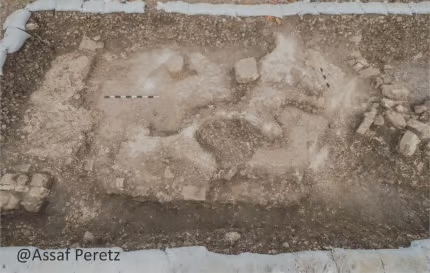
Neolithic plaster floor from Moza. Credit: Yonah Maor, photographer Assaf Peretz.
A new study from the Pre-Pottery Neolithic B site of Moza, just west of Jerusalem, argues that the site’s prehistoric residents mastered a sophisticated plaster technology nearly 9,000 years ago. The researchers claim that the people of Moza created both ordinary lime plaster as well as a harder type involving dolomite. This second type is especially significant because it bears on a long-standing puzzle in geology known as the “dolomite problem,” where dolomite is abundant in ancient rock formations, yet rarely forms today.
Prior to this study, the earliest known examples of dolomitic lime plaster dated to the Roman period, nearly 8,000 years later than the material uncovered at Moza. The researchers are dramatically pushing back the history of this technology, suggesting that the technique may even have been lost to time and then later rediscovered.
Plaster production in the ancient world typically relied on calcite-rich limestone. When fired at high heat, limestone releases carbon dioxide and becomes “quicklime.” Water is then added to create a paste—called slaked lime—which hardens as it dries and turns back into calcite. This process is known as the “lime cycle.” What begins as stone gets transformed by fire into lime and then gradually returns to stone as the plaster cures.
Dolomite behaves differently. Dolomite does not typically return to its original mineral structure after heating. Instead, it breaks apart into a chemically unstable mixture. Scientists do not fully understand why dolomite formed so abundantly in ancient rocks but is rarely found today in newer rocks.

The study’s evidence comes from scientific analyses of more than 180 plaster samples and associated kiln remains. The excavators uncovered more than 100 plaster floors at Moza, along with large fire pits interpreted as lime kilns. Some pits contained limestone while others contained dolomite, suggesting the two materials were fired separately. The team used infrared spectroscopy, X-ray diffraction, thermogravimetric analysis, scanning electron microscopy, and experimental recreations to study the materials.
The researchers found microscopic signs that the dolomite samples had been heated, which would be expected to cause the dolomite to break down. However, some dolomite survived, possibly because it re-formed as the plaster hardened (completing the “dolomite lime cycle”). The authors suggest Moza’s builders recreated dolomite by carefully controlling kiln temperatures. If they are correct, the resulting material would have been stronger and more water resistant than standard lime plaster. The people of Moza may have developed an advanced plaster-making technique thousands of years earlier than any other known example.

Temple that was discovered at Tel Moza. Credit: Natritmeyer, via Wikimedia Commons, CC BY-SA 4.0.
Moza has caused scholarly upheaval before. The discovery of an Iron Age temple near Jerusalem forced archaeologists to reconsider long-held assumptions about the centralization of worship in ancient Judah. Now the site may be forcing scholars to rethink another established narrative: that Neolithic builders were rudimentary. It seems instead that Neolithic communities were solving complex material problems with expertise that would not be matched, let alone surpassed, for thousands of years.
Lauren K. McCormick is an assistant editor at Biblical Archaeology Review and a specialist in ancient Near Eastern religions, visual culture, and the Bible. She holds degrees in religion from Syracuse University, Duke University, New York University, and Rutgers University, and completed a postdoctoral fellowship on religion and the public conversation at Princeton University.
Become a BAS All-Access Member Now!
Read Biblical Archaeology Review online, explore 50 years of BAR, watch videos, attend talks, and more

Related reading in Bible History Daily
All-Access members, read more in the BAS Library
Not a BAS Library or All-Access Member yet? Join today.
Related Posts


Must-Read Free eBooks




Unlock Unlimited Access to the Bible's Past

Unlock Unlimited Access to the Bible's Past
Become an All-Access Member to explore the Bible's rich history. Get Biblical Archaeology Review in print, full online access, and FREE online talks. Plus, enjoy special Travel/Study discounts. Don't miss out—begin your journey today!
