


From Noah’s Dove to the Holy Spirit
Cyprus reveals the sacred history of birds
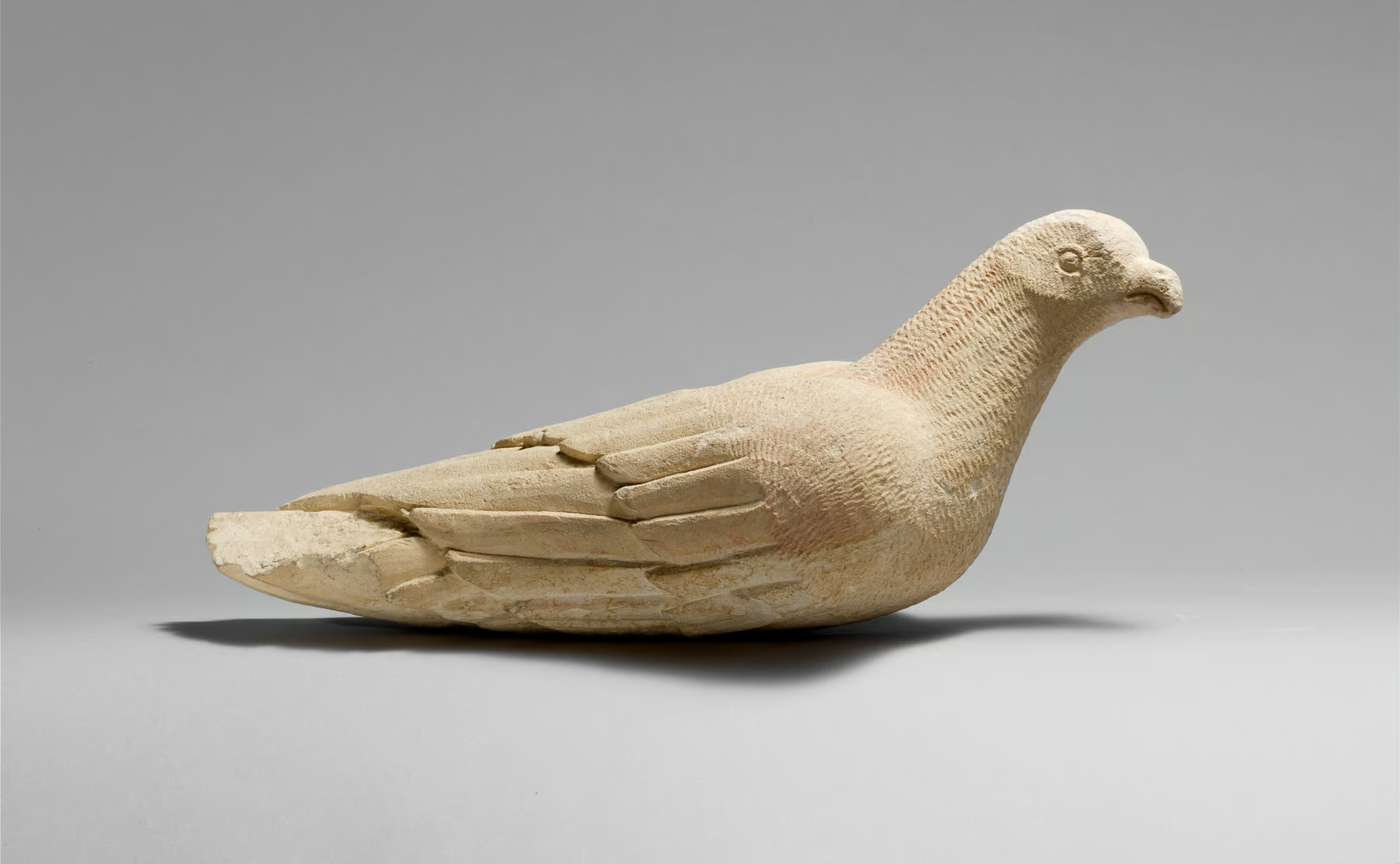
Limestone pigeon sculpture from Cyprus (c. 600–480 BCE). Credit: The Cesnola Collection of Cypriot Art at the Metropolitan Museum of Art, CC0.
Hot take: Pigeons are the most berated animal of all time. Our ancestors domesticated these rock-dwelling birds, for example using them as messengers and food. Over time, the pigeon, and its predecessor, the rock dove, even came to recognize manmade buildings as a substitute for their natural cliff habitats. Though pigeons benefited from proximity to humans, particularly in food availability, we also trained them to stay nearby. But now that we no longer need them, we consider them pests and resent them for occupying the city structures we conditioned them to occupy.
At the Late Bronze Age harbor city of Hala Sultan Tekke in Cyprus, excavations have uncovered a dense assemblage of pigeon bones that sheds light on the early relationship between pigeons and humans. The study argues that pigeons were not simply wild urban scavengers. Zooarchaeological analysis, stable isotope data, and archaeological context suggest the birds lived within or immediately alongside the urban environment, forming a semi-domesticated bird population that may even have been significant to religious life.

Researchers identified at least 55 pigeons from Late Bronze Age deposits (c. 1550–1200 BCE), which is a high number for the period. The presence of juvenile bird bones indicates that the pigeons were breeding within the settlement (as opposed to being hunted and brought in). Further, stable isotope analysis revealed that many of the birds ate remarkably similar diets to humans buried at the site, rather than the varied feeding patterns expected of wild birds. Isotope analysis works by examining the chemical signatures preserved in bone. Different foods leave distinct ratios of elements like carbon in body tissue, which remain in the bones long after death. The pigeon bones showed isotopic signatures that suggest controlled bird feeding or consistent scavenging access. These findings point toward a relationship where pigeons increasingly adapted to human settlement and came to be managed by humans in a way that approached domestication.
Many of the pigeon bones were found in what excavators interpret as ritual-feasting deposits: rooms containing imported pottery, animal remains, furnaces, platforms (altars?), and evidence of repeated communal consumption. Roughly half the pigeon bones showed traces of burning. The birds appear to have been eaten, deposited intentionally, and incorporated into ceremonial activity. The authors cautiously suggest that pigeons may have held symbolic or ritual significance in Late Bronze Age Cyprus. This is especially plausible given that Cyprus was the mythological birthplace of Aphrodite, and pigeons were sacred to her cult.
This ritual dimension makes the assemblage especially resonant within the broader religious world of the eastern Mediterranean, including the traditions preserved in the Bible. Pigeons and doves occupy a surprisingly important place throughout biblical literature, where they appear not only as symbols of peace or purity but as sacrificial animals tied to worship.
The free eBook Island Jewels: Understanding Ancient Cyprus and Crete takes you on a journey to two stunning, history-laden islands in the Mediterranean. Visit several key historical places on both islands and discover many of the great objects that have been unearthed there by archaeologists.
In Leviticus, doves and pigeons are among the few birds explicitly permitted for sacrifice as burnt offerings, purification offerings, and sin offerings. Unlike cattle or sheep, pigeons were economically accessible, becoming the sacrifice of ordinary households and poorer families (Leviticus 5:7). This practical and symbolic role persisted into the New Testament, where Mary and Joseph offer birds after the birth of Jesus in Luke 2:24, signaling modest social status while participating in established ritual law.
The most famous bird episode in the Bible is Noah sending out the dove in Genesis 8. While this is not bird-messenger training per se, it still plays upon that theme. Reflecting awareness of avian homing abilities, Noah releases a bird and it returns with information: dry land has appeared. The dove carries an olive leaf, a nonverbal message that could only have come from land.
Other biblical associations deepen bird symbolism. In the Song of Songs, doves appear as emblems of beauty and intimacy (e.g., Song of Songs 1:15). In the New Testament, the Holy Spirit descends upon Jesus “like a dove” at his baptism (Matthew 3:16), making the bird a lasting emblem of divine presence in Christian art and theology.
The dove accumulates meaning across biblical tradition, from sacrifice, messenger, sign, to spirit. These later meanings, however, may rest upon a much older foundation already visible in Bronze Age Cyprus. The Hala Sultan Tekke pigeons reveal a world in which birds were entwined with human diets, ritual practice, and perhaps divine symbolism itself—a far cry indeed from the nuisance we see on our city ledges today.
Lauren K. McCormick is an assistant editor at Biblical Archaeology Review and a specialist in ancient Near Eastern religions, visual culture, and the Bible. She holds degrees in religion from Syracuse University, Duke University, New York University, and Rutgers University, and completed a postdoctoral fellowship on religion and the public conversation at Princeton University.
Become a BAS All-Access Member Now!
Read Biblical Archaeology Review online, explore 50 years of BAR, watch videos, attend talks, and more

Related reading in Bible History Daily
All-Access members, read more in the BAS Library
Not a BAS Library or All-Access Member yet? Join today.
Related Posts


Must-Read Free eBooks

Unlock Unlimited Access to the Bible's Past

Unlock Unlimited Access to the Bible's Past
Become an All-Access Member to explore the Bible's rich history. Get Biblical Archaeology Review in print, full online access, and FREE online talks. Plus, enjoy special Travel/Study discounts. Don't miss out—begin your journey today!
