


Were Early Christians Class Conscious?
Examining late antique churches with Jacob Ashkenazi
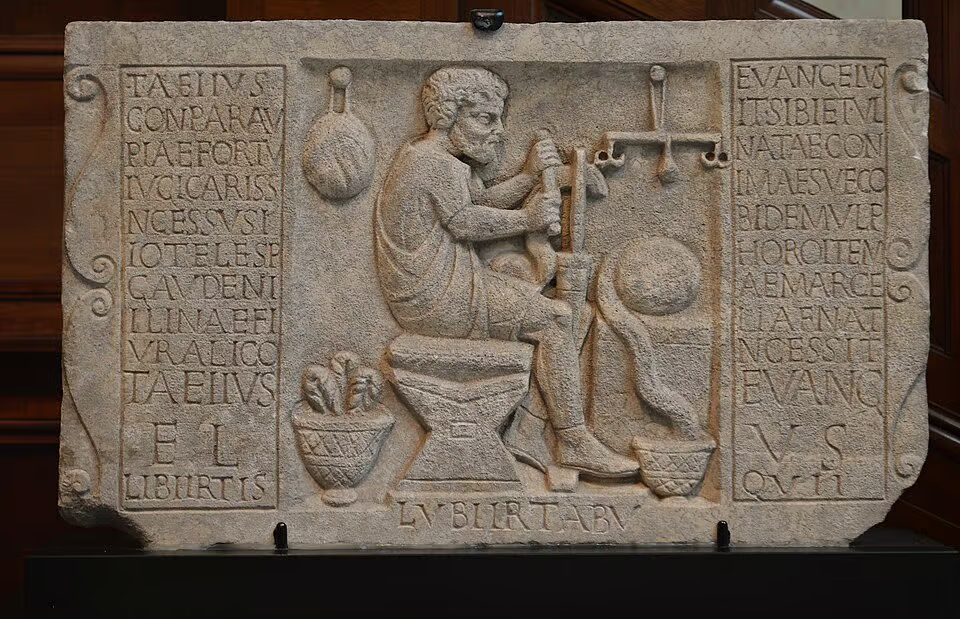
Marble grave relief of a Roman freed slave and craftsman, c. 180 CE. Credit: Lars Thun, via Wikimedia Commons, CC BY-SA 3.0.
In the New Testament, community is central to Christianity. In Acts, believers devote themselves to shared teaching, prayer, and the breaking of bread, while also pooling resources so that “there was not a needy person among them” (Acts 4:34). Paul describes the church as a body in which every member depends on the others (1 Corinthians 12). Together, these texts envision a community bound not only by shared beliefs but by shared responsibility.
Yet the New Testament also acknowledges how difficult this ideal was to achieve. Paul’s letters repeatedly address tensions involving wealth, status, and recognition within Christian communities. The challenge was not simply how to worship together, but how to reconcile a vision of mutual dependence with the realities of social hierarchy and unequal wealth.
In the free eBook Paul: Jewish Law and Early Christianity, learn about the cultural contexts for the theology of Paul and how Jewish traditions and law extended into early Christianity through Paul’s dual roles as a Christian missionary and a Pharisee.
Archaeology offers a fascinating window into how early Christians navigated this tension. Across the late antique Levant (c. fourth–seventh centuries CE), even modest towns and villages could contain an astonishing number of churches. These buildings provide strong evidence of Christian devotion, but they also preserve traces of patronage, family influence, and social ambition. They raise a question that remains relevant today: What happens when ideals of communal equality encounter concentrated wealth?
Across ancient Syria, Jordan, and the Galilee, small towns and villages sometimes contained multiple churches. Early 20th-century excavations by Howard Crosby Butler in Syria first drew attention to this phenomenon in what are now called the “Dead Cities” (see “The Dead Cities of Syria” in the Summer 2026 issue of Biblical Archaeology Review). Well-preserved churches appear scattered with surprising density across these abandoned settlements.
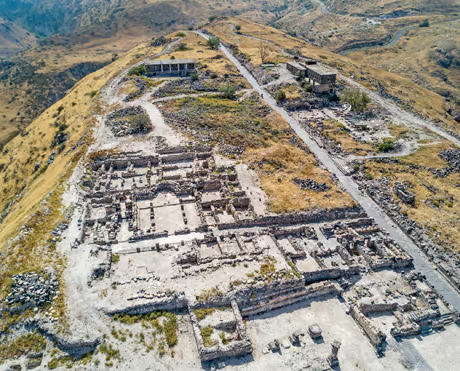
The Greco-Roman city of Hippos-Sussita, by the Sea of Galilee. Credit: Michael Eisenberg, via Wikimedia Commons, CC-BY 4.0.
This is also true for Hippos-Sussita on the shores of the Sea of Galilee, where archaeologists have identified seven churches in a city of only 2,000 to 2,600 people. That makes roughly one church per few hundred residents. In Gerasa (modern Jerash), there were about 17 churches for roughly 10,000 inhabitants. Even smaller rural settlements, such as Umm al-Jimal in northern Jordan, show at least 15 churches serving a population of about 3,000.
These numbers suggest that gathering for worship and communal life was a priority for many Christians. At the same time, maybe so many churches existed because early Christians felt quite siloed from each other. One explanation attributes the proliferation to theological division, with different early Christian groups building separate churches to suit differing practices.
In the Summer 2026 issue of Biblical Archaeology Review, Jacob Ashkenazi proposes another factor worth considering: the role of wealth in shaping the construction of Christian churches and hierarchies.
At Hippos, most churches were embedded in residential areas. The largest, often called a “cathedral,” featured an elaborate three-aisled design and contained not one but two baptisteries, signaling liturgical importance and substantial resources. On the other hand, in villages such as Umm al-Jimal, many churches were integrated into family compounds or residential quarters. Early Christian sacred space sometimes overlapped with household space and other times involved elaborate, freestanding construction projects. In other words, churches were not only places where communities gathered; they were also extensions of the social structures of the communities who built them.

Ashkenazi draws on the concept of euergetism to explain this development, which was a Greco-Roman practice wherein wealthy elites gained honor by funding public works. In the Christianized late antique world, this tradition was redirected: Instead of sponsoring bathhouses or theaters, early Christian elites funded churches.
Inscriptions preserve traces of this phenomenon. At Hippos, a priest named Procopius funded renovations to a church and its baptistery, while commemorating members of his family in the inscription. At Khirbet Khesheq, a deacon named Demetrius built a church dedicated to St. George and recorded multiple generations of his family. At Horvat Erav (Upper Galilee), contributions came from six clergy and five lay donors, showing that church construction could function as a collective act of investment in communal religious life.
These inscriptions reveal genuine investment in religious life, but they also highlight a tension visible already in the New Testament. The book of Acts presents an ideal where resources are shared and no member of the community is cast aside. Yet patronage inevitably created distinctions between those who could fund sacred spaces and those who could not. And beyond this, a family who financed a church could shape its structure, literally and socially. Wealth helped sustain Christian institutions, but it also undermined equality.
The social reach of patronage extended even into monasticism. Monks sought to withdraw from society and its temptations, yet monasteries in regions such as the Hauran (southern Syria) often depended on the support of local elites. The same networks of wealth that built churches also sustained communities dedicated to renouncing worldly status. Even forms of devotion that emphasized separation from society remained connected to broader economic realities—a tough pill to swallow.
Ashkenazi does not suggest that wealthy Christians were insincere, but his framing of church patronage as a path toward prestige raises provocative questions. The inscriptional, archaeological, and scriptural evidence all seem to point to a persistent negotiation between competing values. Christians sought to honor God, strengthen their communities, care for the vulnerable, and leave meaningful legacies. Yet they also existed in tension with a religious tradition that repeatedly warned against the dangers of status, recognition, and attachment to wealth.
Ultimately, the biblical texts and archaeological evidence offer two complementary visions of the early Christian community. The New Testament presents ideals of shared life, mutual dependence, and spiritual equality while acknowledging the contradictions. Archaeology reveals Christians striving toward those ideals in the material world, even as churches became intertwined with family identity, civic pride, and social influence.
Assessing late antique church patronage also raises a deeper question—one that has echoed through Christian history and continues to sound today: Should a community built on ideals of mutual dependence remain comfortable with the inequalities that wealth brings? The New Testament’s vision was never merely to “give more generously.” It imagined a community where the boundary between one person’s suffering, and another’s responsibility, were dissolved.
To learn more about the social role of churches in late antiquity, read the article “Why Did Early Christians Build So Many Churches?” by Jacob Ashkenazi in the Summer 2026 issue of Biblical Archaeology Review.
Subscribers: Read the full article “Why Did Early Christians Build So Many Churches?” By Jacob Ashkenazi in the Summer 2026 issue of Biblical Archaeology Review.
Not a BAS Library or All-Access Member yet? Join today.
Lauren K. McCormick is an assistant editor at Biblical Archaeology Review and a specialist in ancient Near Eastern religions, visual culture, and the Bible. She holds degrees in religion from Syracuse University, Duke University, New York University, and Rutgers University, and completed a postdoctoral fellowship on religion and the public conversation at Princeton University.
Become a BAS All-Access Member Now!
Read Biblical Archaeology Review online, explore 50 years of BAR, watch videos, attend talks, and more

Related reading in Bible History Daily
All-Access members, read more in the BAS Library
Not a BAS Library or All-Access Member yet? Join today.
Related Posts





Must-Read Free eBooks


Unlock Unlimited Access to the Bible's Past

Unlock Unlimited Access to the Bible's Past
Become an All-Access Member to explore the Bible's rich history. Get Biblical Archaeology Review in print, full online access, and FREE online talks. Plus, enjoy special Travel/Study discounts. Don't miss out—begin your journey today!
