


How the Serpent in the Garden Became Satan
Adam, Eve and the serpent in the Garden of Eden
Shawna Dolansky
July 15, 2025
183 Comments
537122 views
Introduced as “the most clever of all of the beasts of the field that YHWH God had made,” the serpent in the Garden of Eden is portrayed as just that: a serpent. Satan does not make an appearance in Genesis 2–3, for the simple reason that when the story was written, the concept of the devil had not yet been invented. Explaining the serpent in the Garden of Eden as Satan would have been as foreign a concept to the ancient authors of the text as referring to Ezekiel’s vision as a UFO (but Google “Ezekiel’s vision” now, and you’ll see that plenty of people today have made that connection!). In fact, while the word satan appears elsewhere in the Hebrew Bible/Old Testament, it is never a proper name; since there is no devil in ancient Israel’s worldview, there can’t yet have been a proper name for such a creature.
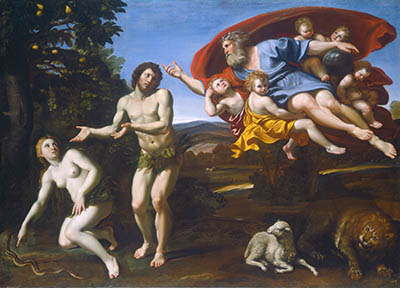
Depicted here are God the Father, cherubim, angels, Adam, Eve and the serpent in the Garden of Eden in Domenichino’s painting The Rebuke of Adam and Eve (1626). Photo: Patrons’ Permanent Fund, National Gallery of Art.
The noun satan, Hebrew for “adversary” or “accuser,” occurs nine times in the Hebrew Bible: five times to describe a human military, political or legal opponent, and four times with reference to a divine being. In Numbers 22, the prophet Balaam, hired to curse the Israelites, is stopped by a messenger from Israel’s God YHWH, described as “the satan” acting on God’s behalf. In Job, “the satan” is a member of God’s heavenly council—one of the divine beings, whose role in Job’s story is to be an “accuser,” a status acquired by people in ancient Israel and Mesopotamia for the purposes of particular legal proceedings.
In Job’s case, what’s on trial is God’s assertion that Job is completely “blameless and upright” vs. the satan’s contention that Job only behaves himself because God has rewarded him. God argues that Job is rewarded because he is good, and not good because he is rewarded. The satan challenges God to a wager that if everything is taken away from poor Job, he won’t be so good anymore, and God accepts. Though a perception of “the satan” as Satan would make this portrait of God easier to swallow, the story demonstrates otherwise; like Yahweh’s messenger in Numbers 22, this satan acts on YHWH’s instructions (and as a result of God’s braggadocio) and is not an independent force of evil.
In Zechariah 3, the prophet describes a vision of the high priest Joshua standing in a similar divine council, also functioning as a tribunal. Before him stand YHWH’s messenger and the satan, who is there to accuse him. This vision is Zechariah’s way of pronouncing YHWH’s approval of Joshua’s appointment to the high priesthood in the face of adversarial community members, represented by the satan. The messenger rebukes the satan and orders that Joshua’s dirty clothing be replaced, as he promises Joshua continuing access to the divine council. Once again, the satan is not Satan who we read about in the New Testament.
The word satan appears only once without “the” in front of it in the entire Hebrew Bible: in 1 Chronicles 21:1. Is it possible that we finally have Satan here portrayed? 1 Chronicles 21 parallels the story of David’s census in 2 Samuel 24, in which God orders David to “go number Israel and Judah” and then punishes king and kingdom for doing so. The Chronicler changes this story, as he does others, to portray the relationship between God and David as uncompromised; he writes that “a satan stood up against Israel and he provoked David to number Israel” (1 Chronicles 21:6–7; 27:24). Although it is possible to read “Satan” here instead of “a satan” (Hebrew uses neither uppercase letters, nor indefinite articles, e.g., “a”), nothing else in this story or in any texts for another 300 years indicates that the idea of an evil prince of darkness exists in the consciousness of the Israelites.
If there’s no Satan in the Hebrew Bible, how does the serpent in the garden become Satan?
The worldview of Jewish readers of Genesis 2–3 profoundly changed in the centuries since the story was first written. After the canon of the Hebrew Bible closed,1 beliefs in angels, demons and a final apocalyptic battle arose in a divided and turbulent Jewish community. In light of this impending end, many turned to a renewed understanding of the beginning, and the Garden of Eden was re-read—and re-written—to reflect the changing ideas of a changed world. Two separate things happened and then merged: Satan became the proper name of the devil, a supernatural power now seen to oppose God as the leader of demons and the forces of evil; and the serpent in the Garden of Eden came to be identified with him. While we begin to see the first idea occurring in texts two centuries before the New Testament, the second won’t happen until later; the serpent in the Garden is not identified with Satan anywhere in the Hebrew Bible or New Testament.
The concept of the devil begins to appear in second and first centuries B.C.E. Jewish texts. In 1 Enoch, the “angel” who “led Eve astray” and “showed the weapons of death to the children of men” was called Gadreel (not Satan). Around the same time, the Wisdom of Solomon taught that “through the devil’s envy death entered the world, and those who are on his side suffer it.” Though this may very well be the earliest reference to Eden’s serpent as the devil, in neither text, nor in any document we have until after the New Testament, is satan clearly understood as the serpent in Eden. At Qumran, though, Satan is the leader of the forces of darkness; his power is said to threaten humanity, and it was believed that salvation would bring the absence of Satan and evil.
By the first century C.E., Satan is adopted into the nascent Christian movement, as ruler over a kingdom of darkness, an opponent and deceiver of Jesus (Mark 1:13), prince of the devils and opposing force to God (Luke 11:15–19; Matthew 12:24–27; Mark 3:22–23:26); Jesus’ ministry puts a temporary end to Satan’s reign (Luke 10:18) and the conversion of the gentiles leads them from Satan to God (Acts 26:18). Most famously, Satan endangers the Christian communities but will fall in Christ’s final act of salvation, described in detail in the book of Revelation.
But curiously, although the author of Revelation describes Satan as “the ancient serpent” (Revelation 12:9; 20:2), there is no clear link anywhere in the Bible between Satan and the serpent in the garden. The ancient Near Eastern combat myth motif, exemplified in the battle between Marduk and Tiamat in Enuma Elish and Baal and Yam/Mot in ancient Canaan, typically depicted the bad guy as a serpent. The characterization of Leviathan in Isaiah 27 reflects such myths nicely:
On that day YHWH will punish
With his hard and big and strong sword
Leviathan the fleeing serpent,
Leviathan the twisted serpent,
And he will kill the dragon that is in the sea.
So the reference in Revelation 12:9 to Satan as “the ancient serpent” probably reflects mythical monsters like Leviathan rather than the clever, legged, talking creature in Eden.
In the New Testament, Satan and his demons have the power to enter and possess people; this is what is said to have happened to Judas (Luke 22:3; John 13:27; cf. Mark 5:12–13; Luke 8:30–32). But when Paul re-tells the story of Adam and Eve, he places the blame on the humans (Romans 5:18; cf. 1 Corinthians 15:21–22) and not on fallen angels, or on the serpent as Satan. Still, the conflation begged to be made, and it will seem natural for later Christian authors—Justin Martyr, Tertullian, Cyprian, Irenaeus and Augustine, for example—to assume Satan’s association with Eden’s talking snake. Most famously, in the 17th century, John Milton elaborates Satan’s role in the Garden poetically, in great detail in Paradise Lost. But this connection is not forged anywhere in the Bible.
 Shawna Dolansky is Adjunct Research Professor and Instructor in the program in Religion at the College of Humanities, Carleton University in Ottawa, Ontario. She coauthored the well-known The Bible Now (Oxford Univ. Press, 2011) with Richard Friedman.
Notes
1. The book of Daniel was the latest book to be included in the Hebrew Bible/Old Testament and dates to about 162 B.C.E.
This Bible History Daily feature was originally published on April 8, 2016.
Related reading in Bible History Daily
All-Access members, read more in the BAS Library
Not a BAS Library or All-Access Member yet? Join today.
Related Posts



Must-Read Free eBooks

Unlock Unlimited Access to the Bible's Past

Unlock Unlimited Access to the Bible's Past
Become an All-Access Member to explore the Bible's rich history. Get Biblical Archaeology Review in print, full online access, and FREE online talks. Plus, enjoy special Travel/Study discounts. Don't miss out—begin your journey today!

Talking about God the Father and the Holy Spirit and the Lord Jesus Christ and the author uses BCE and CE instead of BC AND AD.
REVOLTING AND PAR FOR THE COURSE OF THE LEFT.
If you change words they believe, well, you get “whatever they want to do to you” and if this happens, people, ALL PEOPLE, should come to their aid.
But it always just the left allowed to change things , no one else.
God Bless.
James
the New Testament has so many changes from the old one that it bears little resemblance to it. You teach the New Testament, so according to your claim and ONLY the left can make changes… YOU are the left? im confused here, does that mean you despise yourself? please enlighten us all with some more of your twisted hypocrisy.
The problem here is that you look to the NT to explain the Hebrew Bible, when it should be the other way around. The Hebrew Bible is what you look to, and only with the Hebrew Bible do you explain the NT. If the NT doesn’t match the concepts or meaning found in the Hebrew Bible, then the NT is wrong. The NT directly claims to be built off of the so-called prophetic texts of the Hebrew Bible. If I wrote a research paper about claims of a new religion and I used the Hebrew Bible as my source, my paper would be the one that would have to be criticized because it is making claims of an earlier already-written source.
To put it this way: The Hebrew Bible can be true and the NT false, but the NT cannot be true and the Hebrew Bible false.
When the Adam & Eve story was written, not only was the concept of Satan unknown, but the story had a very different meaning. The “Tree of Knowledge” was the symbol of Asherah (wife of El, the creator god in the Summerian pantheon) in her guise as Goddess of Wisdom. The serpent was the symbol of Asherah in her other manifestation as the Goddess of Fertility. The priests of Yahweh (Hebrew for El) were in a dogfight with the priestesses of Asherah over whether Yahweh was the “only” god, or whether there were many as Abraham’s followers had believed when they lived in Ur. The story–which is the second version of creation in the Bible–was written to try to stamp out Asherah worship. It didn’t succeed until after the Babylonian exile. Meanwhile, Asherah had become Athena and Aphrodite in the Greek pantheon.
Surely you do not have time to read all these comments I’ll be brief. The Serpent in Genesis may represent human concupiscence James 1:14 the tree of life a personal relationship with God John 17:3 the tree of the knowledge of good and evil the human nature of putting oneself before our Creator. which all happpened in real life on Mount Masius.
The introduction of Milton failed to mention Paradise Lost as a plagiarized Adamo Caduto. The verses are almost word for word translations of the work which Milton read and copied when he visited Southern Italy.
In this essay the blogger states that the noun Satan means the adversary or accuser. But that is wrong. The noun Satan means attacker or to attack. Using this noun ” a Satan” can be used for a superhuman intelligence or human intelligence. And “The Satan” means -The Adversary- & -The accuser-. In the Old Testament narrative The Satan was a superhuman intelligence which played a role in the heavenly court, which is where he is recognized as an accuser or prosecutor.
It’s a fine essay from a theological/biblical perspective. The problem here is we have a pre-biblical version of Adam and Eve from Ugarit with additional details, like an extra god Horanu. Without considering this original version, I feel that this essay is outdated.
https://www.researchgate.net/publication/265184845_Review_of_Adam_Eve_and_the_Devil_by_Marjo_Korpel_Johannes_de_Moor_Sheffield_2014
-Since this site is focused on archeological attributes of religion, you might find a lot that can be interesting and history changer if you direct your attention to the real geo religious history of southern Arabia and its African opposing redsea coast ; nowadays Yemen, saudia Arabia , Oman , eritria, djebouti, Sudan, Somalia …..
– another thing , you may find in the link to follow answers for most of the perplexities propagated by the Jewish biblical writers and the post Christ birth biblical writers …. the disastrous mix between what remained from the holy devine revelations ( books) to Moses meaning the Tawarah-Torah and Jesus “the Christ ” meaning the Injil-Gospel
I also as a Bible believing Christian get tired of all the misinformation and derogatory remarks made by these so-called “professors” who all they do is try without effect to discredit and slander the Word of God………….Satan is REAL whether some of you want to believe it or not will be you own failing in the end…………..Christ spoke of the devil throughout the New Testament and specifically in 2 keys moments recorded; the first while he was in the desert for 40 days/nights undergoing Satan’s temptations and secondly while in the Garden of Gethsemane………BUT of you consider those historical events just stories then of course the whole idea behind your research is already biased and flawed…………Their are hundreds of early church writers who wrote specifically on the topic who would have had better historical evidence if you desire than we have today because many of these papers/documents unfortunately were destroyed and burned in countries waring with others over the centuries……..YES indeed we are are worst enemy t most times because in 2023 we are still killing the innocents for needless personal gain but that does not nor ever will dismiss Satan as being our #1 adversary here on earth
Exactly. Besides all that, people tend to selectively argue from certain sources that give them either misinformation or disinformation, and then the run with it. They also just make things up out of thin air against the Biblical evidence by saying things like, ” like Yahweh’s messenger in Numbers 22, this satan acts on YHWH’s instructions (and as a result of God’s braggadocio) and is not an independent force of evil.” Yeah, right. The text itself mitigates against such a claim, as a personal, evil, spirit being is having a conversation with another Personal, spirit Being.
So we can’t take such claims seriously, since they have no sound basis in good exegesis and understanding of the actual text, and seeks to only subvert what the text says and means.
I agree David. There is this massive attempt to deconstruct the bible to no more than a comic book by scholars who should know better. Also are we to discard the testimony of demonic possession as witnessed by many catholic priests who are highly trained theologians or people who,have witnessed demonic occurences within their home. Why are so many scholars so obsessed with the bible if they believe it largely to be a work of fiction. Because there is potentially big money to be made out of discrediting the bible or doing real work like a priest has to attending to their flock.
The Hebrew word NaChaSh is usually translated ‘serpent’ or ‘snake’, but its actual literal meaning is ‘Hisser’ and/or ‘Whisperer’. Since a serpent does make hissing sounds, then it qualifies as a ‘Hisser’ or ‘Nachash’ . . . but so does a Whispering Man or ‘god’ or ‘angel’.
The story in GENESIS is like an Ovidian tale from the METAMORPHOSES, where a Whispering being — a literal ‘Nachash’ — is punished for ‘seducing’ Eve and Adam by being transformed into a different kind of ‘Nachash’, the ‘Hissing’ kind: a literal Serpent.
The writers of GENESIS considered Snakes and Worms to be essentially the same kind of creature, a limbless tube-shaped slitherer with a head at one end. One of the punishments this ‘Serpent’ is to endure is to eat dust of the earth — which is something that earthworms are thought to do, but actual snakes do NOT do. The author(s) of GENESIS conflate the two types of creatures, in the mistaken belief that a Snake is a kind of ‘dust’-eating Worm and/or vice versa, that earthworms make hissing noises and, thus, can be referred to as ‘Hissers = ‘Serpents’.
It’s no wonder that medieval bestiaries would refer to a Dragon, too, as a ‘Worm’ or ‘Wyrm’. The English word ‘Vermin’ comes from the same linguistic root.
The Jews believe Moses wrote the first five books of the Bible c.1500 B.C. Moses was raised in Pharaoh’s court and knew all about snakes and their life cycle. He was not confused between snakes and worms nor what each ate.
Satan was allowed by God to test Adam & Eve for virtue. Paul tells us that Satan can appear as an angel of light. So, Satan can be seen if he wants to. Apparently Adam & Eve both heard the serpent talking. What this animal originally was or looked like cannot be know, but it may well have been somewhat serpent like. It did not hiss but spoke to Eve. Apparently Satan was allowed to indwell this creature or use its physical appearance as a prop and may have spoken to Eve without being seen. The rabbis say Satan hissed an incantation that lulled Eve to eat the fruit. But this is doubtful as Adam also ate the fruit when it was offered to him without saying a word.
While we do not know what the creature looked liked before it was cursed, the skeletons of snakes still contain front and back legs. So this animal may have walked upright or crawled. None of this would have startled Eve as she was new to the Garden and accepted the creature and their conversation at face value
this is something recently discovered about the garden.very helpful indeed. n why Jesus says few times about some people being children of the dvl. if someone is not an enemy to it,they belong to it.if someone is at odds with evl. they are the children of Eve,interestingly 4000 yrs later,the dvl.decrees that Marys children ,who with the mark of God on there forehead was his enemies…that was pre established with God 4000 yrs earlier in the garden,this also points to that off spring of Eve and Mary are the same,thru Gods established enmitie between to 2
explains why God isnt enemies with the evl ones,the enemies are between the talking snake children and the children of Eve n Mary