


Excruciating Exodus Movie Exudes Errors
Exodus: Gods and Kings reeks with wretchedness
Note: This discussion of Ridley Scott’s Exodus: Gods and Kings (2014) contains spoilers.

Colossal expense equals colossal waste for the new Ridley Scott movie Exodus: Gods and Kings (2014). The story has been changed so much from the Biblical narrative that it is barely recognizable.
My mother always taught me that if I don’t have anything nice to say, I should say nothing at all. If I were to follow her policy, this review of Ridley Scott’s Exodus: Gods and Kings (2014) would end now.
I should say I am not a purist. I understand that Biblical material needs to be added to in order to make a motion picture. After all, very rarely does the Bible give a physical description of a character. I also understand that changes might need to be made for technical reasons or to make the story flow—though Scott’s explanation for the racial make-up of his casting falls flat. Heck, I even like Dan Brown books. Sure, I notice the inaccuracies, but the man tells good stories. So why am I annoyed that Exodus: Gods and Kings bears almost no resemblance to the Biblical narrative? Because it pretends to be something that it is not.
It is beyond me to understand why one of the most action-packed, intense Biblical narratives needed such dramatic altering by writers Adam Cooper, Bill Collage, Jeffrey Caine and Steven Zaillian. Their story was so different that if they didn’t use the Biblical names and released the same movie with a different title, I might not have even recognized it—especially with all the Arthurian mythology woven in—though the caricature and stereotypes that ran through the film shoved the viewer in that direction.
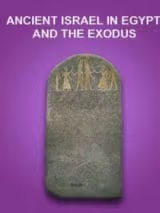

Not only have the exciting Biblical elements, such as a lonely baby floating down a raging Nile, a hero with a speech impediment sent to speak to the most powerful leader in the world, a brotherly side-kick, been edited out of the movie, God has been turned into a petulant child. This is the precise opposite of the narrative, which depicts a God who has control of every element of nature, including death and Pharaoh. But movie Moses’ exasperated cry, “Who are you punishing?” misses the textual point that the Hebrews were not subjected to the majority of the plagues. I should not be surprised as it seems no one involved with this movie has ever read the Biblical account. This comic visually demonstrates the plague of darkness that affected the Egyptians but not the Israelites (Exodus 10:22–23). Image: bit.ly/1C3fxnd courtesy Barer at Pardes Institute of Jewish Studies.
The movie is manipulative in its anti-religious polemic. All the supernatural elements of the story (which are in the Bible to make theological points about the God of the Hebrews and thus are literarily important to the characterization of God, regardless of one’s faith position) are stripped away or given a “scientific” explanation within the dialogue. It’s amazing that the movie had time for that when it rushed through the plagues. To my count, only eight or possibly nine were depicted (though the alligator plague might be an improvement on the text). The Egyptian priestess (apparently there was only one in Memphis) and the prophet are slain for incompetence. Moses is a firm atheist until he suffers a traumatic brain injury which makes him hallucinate a boy-god. Which brings us to the petulant, malicious boy-god, who plagues the Hebrews alongside the Egyptians, ignores Moses’ pleas for mercy and binds the Hebrews to him without choice in the final plague. All of these alterations were designed to make religion look senile. This is misdirection at best considering the blatant attempt to attract religious viewers with the movie’s “Biblical” subject matter.
My intention was to create a list of all the changes made to the text, the historical inaccuracies and the archaeological brutalities, but there are just too many of them. To do this would result in a review that was twice the length of the script itself. Even where I might be able to offer praise at the movie’s use of paleo-Hebrew (a single rudimentary mem), it was written on a full sheet of papyrus by a slave. Seriously?! What slave can afford to buy papyrus? Not to mention can read or write? I know I am not supposed to ask these questions, but I am also supposed to find at least something nice to say about everything. I guess I am just not very good at doing what I am supposed to.
Leaving aside the mutilations to the text, the historical record and the archaeological remains, the melodramatic nature of the characters made them phony and dislikable. Thus, even if you can put everything else aside, I would still recommend you skip this incredible waste of time and money.
For more on Hollywood movies, read “The ‘Gods of Egypt’ Movie: A Mess of Anachronisms and Exoticization,” “Rock Giants in Noah” and “Blending into One: The ‘Left Behind’ Movie, the Book of Revelation and the Rapture.”
 Ellen White, Ph.D. (Hebrew Bible, University of St. Michael’s College), is the senior editor at the Biblical Archaeology Society. She has taught at five universities across the U.S. and Canada and spent research leaves in Germany and Romania. She has also been actively involved in digs at various sites in Israel.
More on the Exodus in Bible History Daily:
Exodus in the Bible and the Egyptian Plagues
Who Was Moses? Was He More than an Exodus Hero?
Out of Egypt: Israel’s Exodus Between Text and Memory, History and Imagination
Searching for Biblical Mt. Sinai
Related Posts



Must-Read Free eBooks

Unlock Unlimited Access to the Bible's Past

Unlock Unlimited Access to the Bible's Past
Become an All-Access Member to explore the Bible's rich history. Get Biblical Archaeology Review in print, full online access, and FREE online talks. Plus, enjoy special Travel/Study discounts. Don't miss out—begin your journey today!

Why didn’t God make Pharaoh release his chosen ones?
It never happened, it was just a story to encourage the Worship of ‘God’ by those who wanted power and control of the Masses.
I understand that Moses may have been a general in pharaohs military before he fled Egypt.
@Martin
The God of the Bible never forces anyone to do anything. He may command people to do things, but they don’t always do them (to their detriment, of course. It is the Bible, after all), their own agency is never compromised.
The message being, of course, that doing the right or wrong thing comes from the individual. It would be out of character for such a God to ‘make’ Pharaoh do anything.
I believe the Bible from cover to cover! However, not by Blind Faith that others tell me to believe. For example the year of Jubilee “Was a good time for all”. NO! it was a time of lack. If you were prepared as Bible told you to be you were in good shape. Then about every ten years of Jubilee it was really Bad! IF you do the math you will find that Joesph was in the middle of a bad period, about 500 _ 50 years later. Moses was on the scene. About 500 _ years later David was having a bad time, 500 _ 50 years later the Jews went to Babylon. What did these time have in common? A astrological manifestation which the Egyptians called the Eye of Thoth. GOD used this astrological manifestation to cause the problems. Even to the draining of the Red Sea. The Moon and Sun causes high tides on both sides of the planet at the same time.Add a third astrological manifestation and the tides would cause an extremely low tide in the Red Sea basin.
Thanks, Dr. White. Based on your review, I will not be seeing the film, and will in that way avoid a lot of aggravation and disgust. Also, I have enjoyed and learned from all of your articles that I have read. Thanks again. ben
Slow clap!
I have told all my friends NOT to waste money seeing this in a theater, but wait until it is available via streaming video, hopefully, for free on Netflix.
“It is beyond me to understand why one of the most action-packed intense Biblical narratives needed such dramatic altering by writers ”
EXACTLY!!!!
You mean Hollywood didn’t make an accurate movie on Biblical/Historical events, as directed by a self proclaimed atheist? I cannot say that I am surprised by this.
Perhaps it’s partly because current mainstream thought generally considers Biblical stories like Exodus to have such scant historical merit that its not just acceptable – but artistically necessary – to freely reinterpret what is only a mythologized folk tale to begin with. And if it disgruntles a few people along the way and manages to get the indulgent re-rendered elements labeled as controversial or in some way note worthy then all the better for their fishing hopes of boosting boxoffice exposure.
After reading some of the other comments posted here already, evidently fans of Biblical history are becoming more jaded though. Like others, I completely expected a lot of Biblical and historical ridiculousness from this movie. I’ve only seen the trailer but this article and comments seem to confirm my expectations.
I think the core Exodus story has a lot of value because helps us see the primal monotheistic idea of Biblical “holiness” (as in purity by way of some kind of separateness and differentiation) developing as the Israelites were emerging as an identifiable people in the region
For clarity I should explain that in my above comment when I referred to the “core Exodus story” having value…
I meant the actual story and not the movie. Hopefully I wasn’t being too confusing with that…
I haven’t seen the movie, but would bet that three things are omitted or distorted:
1) That the parents of Moses and Aaron were an aunt and her nephew;
2) That Moses tried to con Pharaoh saying that the Hebrews just wanted to go out to the desert for a sacrifice, but would need all their cattle since the Lord would have to select the sacrificial animal (Pharaoh wasn’t fooled for a minute);
3) That after each plague Pharaoh decided to release the Hebrews but the Lord intervened and hardened Pharaoh’s heart. (He evidently wanted to use all His plagues.)