


The Sayings of Jesus in the Gospel of Thomas
Simon Gathercole examines the enigmatic Gospel of Thomas
Jesus says, “Blessed is the lion that a person will eat and the lion will become human.”
Jesus says, “Every woman who makes herself male will enter the kingdom of heaven.”

This third-century papyrus leaf—known as POxy 1—was discovered at Oxyrhynchus in Egypt and contains sayings of Jesus written in Greek. Scholars later determined the text was from the elusive Gospel of Thomas referenced by early Church Fathers. Photo: Bodleian Library, University of Oxford.
These bizarre statements are two of the 114 sayings of Jesus found in the Gospel of Thomas. The Gospel of Thomas is a non-canonical collection of the sayings of Jesus reputed to have been dictated to the apostle Thomas. In “The Gospel of Thomas: Jesus Said What?” in the July/August 2015 issue of Biblical Archaeology Review, New Testament scholar Simon Gathercole examines what these 114 sayings of Jesus reveal about the early Christian world in which they were written.
A work called the Gospel of Thomas has long been known from references by Church Fathers as far back as the third century. What was actually in the Gospel of Thomas, however, remained elusive until the 20th century. Excavations at an ancient garbage dump in Oxyrhynchus, Egypt, around the turn of the 20th century uncovered papyri fragments containing sayings of Jesus that had been dictated—the papyri claimed—by Jesus to his disciple Thomas. Scholars date these papyri to the early to mid-third century C.E.
Did these Greek fragments from Oxyrhynchus belong to the Gospel of Thomas? The discovery of the Nag Hammadi codices in late 1945 to early 1946 near Nag Hammadi, Egypt, verified that the Oxyrhynchus fragments were indeed from the Gospel of Thomas: In one of the Nag Hammadi codices was a complete Coptic translation of the Gospel of Thomas’s sayings of Jesus.
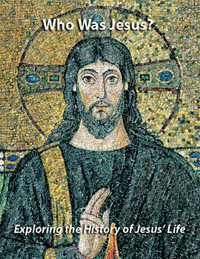
 Is the Gospel of Thomas “Gnostic”? Were these sayings of Jesus attributed to a religious group—“the Gnostics”—who offered an alternate view of early Christianity? Simon Gathercole unpacks the meaning of these questions in his BAR article:
Those who have thought that Thomas is Gnostic have seized upon the negative views of the body and the world evident in the book. And it is certainly true that the body and the world are seen in a negative light in Thomas. For example, in talking about the fact that the soul or spirit has come into the body, Jesus says: “I do marvel at how this great wealth has come to dwell in this poverty!” (Gospel of Thomas 28.3). The opposition of “wealth” and “poverty” shows up the sharp contrast between the precious soul and the worthless body. Jesus is similarly negative about the material cosmos: “Whoever has come to know the world has found a corpse” (Gospel of Thomas 56.1). In Thomas, to be dead like a corpse is to be in the realm of ultimate perdition; to be classed as “dead” is about as bad an insult as can be hurled.
Nevertheless, it has always been something of an embarrassment for the “Gnostic” view of Thomas that there is no talk of an evil demiurge, a creation that is intrinsically evil, or of other familiar themes such as “aeons” (a technical term for the divine realms in the heavens). […] But neither does it work to see Thomas as simply a stone’s throw from the kind of Christianity or Christianities evident in the New Testament and in “apostolic fathers” such as Clement of Rome, Ignatius and Polycarp.
What else does the Gospel of Thomas say? Click here to read the 114 sayings of Jesus as translated by Stephen J. Patterson and James M. Robinson. And learn more about the Gospel of Thomas and what it reveals about Jesus and early Christianity by reading the full article “The Gospel of Thomas: Jesus Said What?” by Simon Gathercole as it appears in the July/August 2015 issue of BAR.
BAS Library Members: Read the full article “The Gospel of Thomas: Jesus Said What?” by Simon Gathercole in the July/August 2015 issue of Biblical Archaeology Review.
Not a BAS Library or All-Access Member yet? Join today.
Related reading in the BAS Library:
Biblical Views: What’s Up with the Gospel of Thomas?
Nag Hammadi Codices Shed New Light on Early Christian History
Not a BAS Library or All-Access Member yet? Join today.
Is it possible to identify the first-century man named Jesus behind the many stories and traditions about him that developed over 2,000 years in the Gospels and church teachings? Visit the Jesus/Historical Jesus study page to read free articles on Jesus in Bible History Daily.
This Bible History Daily feature was originally published on June 29, 2015.
Related Posts


Must-Read Free eBooks

Unlock Unlimited Access to the Bible's Past

Unlock Unlimited Access to the Bible's Past
Become an All-Access Member to explore the Bible's rich history. Get Biblical Archaeology Review in print, full online access, and FREE online talks. Plus, enjoy special Travel/Study discounts. Don't miss out—begin your journey today!

As an evangelical Bible believing Christian I do not find a great deal of positivity in the articles of Bible History Daily.
Strangely, I am left with the feeling that I am often reading `agnostic authors` rather than those who desire to prove bible history!
KC
George says:
“The fact that the papyri were found in a garbage dump is about all I need to know. I’m sure there were those out to discredit Jesus and His Church. Propaganda is certainly not a modern concept.”
The “Infancy Gospel of Thomas” concentrates on Jesus as a child—between 5 and 12 years of age—and credits him with performing a series of far-fetched miracles. (See John 2:11.) Jesus is presented as a naughty, irascible, vindictive child, who uses his miraculous powers to take revenge on teachers, neighbors, and other children, some of whom he blinds, cripples, or even kills.
For example, the apocryphal Gospel of Thomas ascribes a number of strange utterances to Jesus, such as saying that he would transform Mary into a male to make it possible for her to enter into the Kingdom of heaven. The Infancy Gospel of Thomas describes young Jesus as a mean-spirited child who deliberately caused another child’s death. The apocryphal Acts of Paul and Acts of Peter emphasize complete abstinence from sexual relations and even depict the apostles as urging women to separate from their husbands. The Gospel of Judas depicts Jesus as laughing at his disciples for praying to God in connection with a meal. Such notions are at odds with what is found in the canonical books.—Mark 14:22; 1 Corinthians 7:3-5; Galatians 3:28; Hebrews 7:26.
Many of the apocryphal writings reflect beliefs of the Gnostics, who held that the Creator, Jehovah, is not a good God. They also believed that the resurrection is not literal, that all physical matter is evil, and that Satan was the source of marriage and procreation.
A number of the apocryphal books are attributed to Bible characters but falsely so. Did some dark conspiracy exclude these books from the Bible? One expert on the apocrypha, M. R. James, said: “There is no question of any one’s having excluded them from the New Testament: they have done that for themselves.”
https://wol.jw.org/en/wol/d/r1/lp-e/1200270408
I’d like to see a competition archeological magazine that adheres to actual Biblical facts real Christian history and doesn’t waste time, words, and space on what we all know is blatant heresy.
It’s gnostic garbage!! Who with reputation respects this book?
There seem to be few who comment here who are not simply looking for simple minded confirmation of the simplistic assumptions of their recently invented religion: American literalist evangelicalism. Truth and love are unending paths of growth and discovery, and commitment to these paths (in the NT, the disciples called their religion The Way) is to be alive. To arrogantly asume one knows what needs to be known, and to dismiss that which challenges this dead knowledge is not faith, but the very sort of arrogant prejudice we see Jesus attack so often in the gospels. The ancient Orthodox Church has known and taught this for 2000 years, and Christ himself reserved his sternest condemnations for proud religious bigots who assumed they were right and attacked others on that basis. The Gospel of Thomas was taken seriously by ancient Christians; perhaps modern Christians would do well to consider it with more humility and wonder.
I agree with Kurt’s cited quote, that the apocryphal books have excluded themselves from the New Testament, if only for the fact that they are inconsistent with the rest of the books, down to the very core. And to ridicule and belittle Christians who are practicing God-given DISCERNMENT (which is gifted *by* the Holy Spirit, *through* Jesus Christ) is what is truly arrogant.
I had the same thought as George H. Finding them in a dump is the first clue of what the ancients thought of it, so that’s my big clue that the contents are just that, garbage.
I used to be an avid reader and subscriber of BA until they went all modern and
wacka-doodle on me and I just had to give it up. Hated it, because it is a very pretty publication.
The Gospel of Thomas is a forgery. The writing style is completely different from that used in the region at the time of Jesus and the apostles but very familiar with Babylonian texts.
I believe it to be from a campaign of dis-information or propaganda if you will.
There are books in the NT that are older than Thomas and some are even falsely attributed to their authors. Yet it doesn’t seem to cause any stir among believers. But when a document with simple, coherent teaching shows up they are immediately repulsed. It was not found in a dump, it was found sealed and protected in a jar, which means that the disciples valued these books. Thomas shows that Jesus’ understanding of Life and Death was more nuanced, it’s something our narrow literalistic minds can’t comprehend. Oxyrhynchus papyri are some of the oldest Biblical manuscripts ever found. Just to put things into perspective, the oldest papyrus we have is a credit-card-sized fragment P52 from 125 CE. The earliest complete manuscripts date well after 200 CE.