


Was Edom Originally Nomadic?
Finding social complexity in desert archaeology
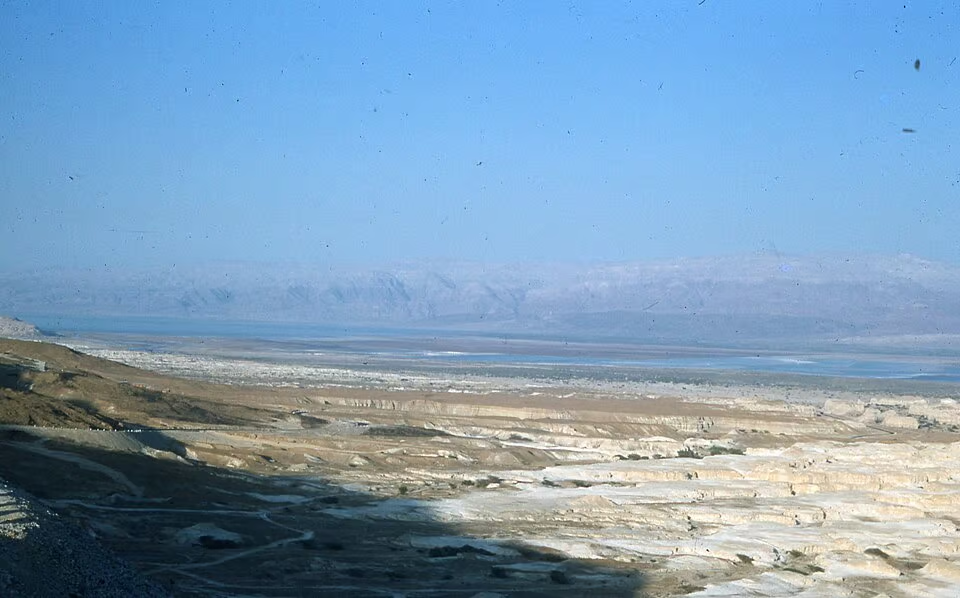
The Arabah Valley. Credit: Benno Rothenberg /Meitar Collection / National Library of Israel / The Pritzker Family National Photography Collection / Israel State Archives, CC-BY 4.0, via Wikimedia Commons.
A recent article by archaeologist Erez Ben-Yosef has reignited debates about nomadic societies, the kingdom of Edom, and, by implication, how the Bible has been used to interpret the archaeological record. His central claim is that the hundreds of Iron Age sites found in the Negev highlands of southern Israel were not permanent settlements. Instead, they were specialized installations used by a mobile or nomadic polity linked to the copper industry of the Arabah Valley, the desert region east of the Negev that connects the Dead Sea and the Red Sea.
Ben-Yosef argues that recent radiocarbon dates suggest that the Negev highlands sites were occupied over a broader period than pottery studies once indicated (pottery typology and radiocarbon are two different methods of dating). He finds that Negev highland occupation roughly corresponds with a period of intense copper production in the Arabah from roughly the 11th to ninth centuries BCE. This chronological overlap suggests a connection between the sites and the copper industry: The sites were used in moments when copper was being mined.
Ben-Yosef also finds that pottery shows strong links between the Negev highland sites and copper-producing regions farther south. Much of the pottery appears to originate in the Arabah, implying that the same populations who worked in the copper industry also used the highland sites.
Third, and perhaps most significantly, Ben-Yosef notes that agriculture is strikingly absent from the Negev highland sites. Scientific studies have failed to uncover signs of farming or grain storage. Terraces once thought to be from the Iron Age have now been dated much later. If these highland sites were permanent villages, one would expect at least some evidence of agriculture.
Finally, the spatial arrangement of the sites is unusual. Rather than forming clusters of villages surrounded by farmland, they are distributed along ridges and corridors. Ben-Yosef interprets the Negev highland sites as trading hubs, storage facilities, defensive outposts, and territorial markers used by a nomadic society engaged in copper production and trade.
Archaeologists may have misunderstood these sites because of what Ben-Yosef calls an “architectural bias.” Modern scholars often assume that stone buildings indicate permanent settlement and that political complexity requires cities, palaces, and monumental architecture. Ben-Yosef argues that this assumption obscures the possibility that highly organized nomadic societies could exercise territorial control, coordinate large industries, and participate in international trade while leaving behind relatively little archaeological evidence.
Ben-Yosef’s argument has important ramifications for understanding the biblical world. He suggests that the copper-producing polity he detects may have been an early form of what later became Edom, a kingdom frequently mentioned in the Hebrew Bible. If he is correct, Edom may have existed as a politically organized, nomadic entity prior to the emergence of the better-known Iron Age urban settlements. At the same time, Ben-Yosef’s identification of this polity with Edom depends in part on biblical and other textual references. Ben-Yosef himself acknowledges that alternative reconstructions are possible and emphasizes that such questions are best approached through the evaluation of competing historical interpretations.
Lauren K. McCormick is an assistant editor at Biblical Archaeology Review and a specialist in ancient Near Eastern religions, visual culture, and the Bible. She holds degrees in religion from Syracuse University, Duke University, New York University, and Rutgers University, and completed a postdoctoral fellowship on religion and the public conversation at Princeton University.
Become a BAS All-Access Member Now!
Read Biblical Archaeology Review online, explore 50 years of BAR, watch videos, attend talks, and more

Related reading in Bible History Daily
All-Access members, read more in the BAS Library
Not a BAS Library or All-Access Member yet? Join today.
Related Posts




Must-Read Free eBooks


Unlock Unlimited Access to the Bible's Past

Unlock Unlimited Access to the Bible's Past
Become an All-Access Member to explore the Bible's rich history. Get Biblical Archaeology Review in print, full online access, and FREE online talks. Plus, enjoy special Travel/Study discounts. Don't miss out—begin your journey today!
