


The History of the Tetragrammaton
How YHWH became Jehovah
John Drummond
February 08, 2023
26 Comments
79633 views

The four-letter name of God, YHWH, also known as the tetragrammaton, represented in the Phoenician (top line), Old Hebrew (middle line), and modern square Hebrew (bottom line) scripts. Image credit: Zappaz created the png file, Bryan Derksen created the SVG file, CC BY-SA 3.0, via Wikimedia Commons
There is a famous movie scene in which the world’s most notorious archaeologist, Indiana Jones, must pass a series of harrowing trials in order to reach the Holy Grail. In one of these trials, Indy must traverse a particularly deadly trap by only stepping on the stones marked with the letters that make up the name of God. Indy does so and then everyone gets to learn that in Latin the name “Jehovah” starts with the letter I—after Indy almost dies by stepping on the letter J.
In reality, Indy would have fallen to his doom anyway because the name Jehovah did not appear until the 16th century when William Tyndale introduced it to the world in his translation of the Book of Exodus. Indeed, the Crusaders who, at least in Steven Spielberg’s film, built the booby-trapped temple of the Grail would have simply used “Dominus,” the word used for the name of God in the Latin Vulgate version of the Bible. Likewise, if the trials had been devised by a Judean of the Second Temple period, like Joseph of Arimathea—the keeper of the Holy Grail according to medieval legend—Indy would have only had to walk on four letters—YHWH—known to many as the Tetragrammaton.
It is this four-letter Hebrew word that William Tyndale would eventually translate into the name Jehovah. Unfortunately, Tyndale was unfamiliar with the word’s history. Because of the perceived holiness of God’s name, many observent Jews never uttered it aloud. Instead, they say haShem (“the name”) or Adonai (“my Lord”), a tradition that dated back to at least the Hellenistic period (c. 332–37 BCE). This was so important that when the Hebrew vowel system was invented in the Middle Ages, the rabbis that penned the scriptures chose to add the vowels for Adonai onto the Tetragrammaton as a reminder not to say God’s true name out loud. It was these Hebrew texts that Tyndale used to make his translations, which ultimately became the basis for the Old Testament of the King James Version of the Bible in 1611. And the rest is history.
The true pronunciation of YHWH can never be truly known because of the nature of the language, but clues do exist, including theophoric personal names known from the Bible and archaeology that reference YHWH—names such as Elijah, Adonijah, and Jeremiah. This led to the most commonly accepted pronunciation, “Yahweh,” but even this is still debated. Because of this uncertainty, many simply just use YHWH for the name.

Like the pronunciation, virtually everything about the name YHWH is debated—its origins, its significance, etc.—as is every aspect of the religion of the god who bears the name. In the article “Yahweh’s Desert Origins,” published in the Fall 2022 issue of Biblical Archaeology Review, scholar Juan Manuel Tebes discusses the ongoing debate surrounding the origins of Yahweh and the evidence that the deity may have been first worshiped by nomadic tribes living east of Sinai—people known to the Egyptians as the Shasu.
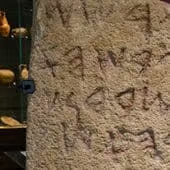
Regardless of the origins of Yahweh worship, it is clear that by the United Monarchy (c. tenth century BCE), Yahweh had become a very important deity to the people of Israel and Judah. It is at this time that personal names honoring YHWH become prevalent, replacing those of earlier Canaanite deities in popularity. By the mid-ninth century, when Mesha, king of Moab, erected his famous victory stela at his capital in Dibon, YHWH had become the national deity of the kingdoms of Israel and Judah, officially recognized by their neighbors and enemies. And since then, the name YHWH has been firmly cemented in history.
To further explore the historical origins of Yahweh and how he came to be the patron deity of Israel and Judah, read Juan Manuel Tebes’s article “Yahweh’s Desert Origins,” published in the Fall 2022 issue of Biblical Archaeology Review.
Subscribers: Read the full article “Yahweh’s Desert Origins” by Juan Manuel Tebes in the Fall 2022 issue of Biblical Archaeology Review.
Read more in Bible History Daily:
All-Access members, read more in the BAS Library:
The Name of God in the New Testament
Why God Has So Many Names
Not a BAS Library or All-Access Member yet? Join today.
Related Posts



Must-Read Free eBooks


Unlock Unlimited Access to the Bible's Past

Unlock Unlimited Access to the Bible's Past
Become an All-Access Member to explore the Bible's rich history. Get Biblical Archaeology Review in print, full online access, and FREE online talks. Plus, enjoy special Travel/Study discounts. Don't miss out—begin your journey today!


God allows us to translate. He proved this at Tower of Babel and Pentacost. Don’t get caught up in all the legalism, its the devils tool, roadblock to evangilizing. As long as your heart is for God, its ok to know ancient as well as common language translations. Nobody is going to convert world to old world Hebrew, Greek or Arimaic. Thank you for the article this is difficult subject.
Legalism? Legalism, in a Christian, or New Testament, context is when man places a prerequisite upon the attainment of salvation, that the LORD never required, for example, “circumcision” among Gentile believers in Christ. The Tower of Babel can in no wise legitimize the transforming of the name of salvation into an entirely different name. The issue is not translation, for example, in Hebrew, “You shall not murder,” as it is in English the same meaning, however, when the apostle Peter makes it clear, that there is no other name (Acts 4:12), YAHSHUA, and man takes the common Aramaic name Yeshua and transliterates it to Iesous, an entirely different name that has no intrinsic meaning regarding salvation, that is a problem! How can you talk of “your heart is for God,” which is a subjective thing, as many have fooled themselves into thinking their heart is for God (Matthew 7:21-23), and yet that heart is in defiance, by the traditions of men, to the revelation of the LORD? When one does not follow the commandments of God, that is the will of the Father, this is what the Gospel warns us about these “workers of lawlessness!” The LORD revealed a name and every tongue, regardless of language, is to know this revealed name, as the main prerequisite of the LORD (Philippians 2:9-11). The Savior has the name, YAH, the name which is above every name, not to be subjected to linguistic evolution caused by man.
Mr. Haydu, I agree, “God allows us to translate.” However, I do not agree, that God allows us to transliterate His name into an entirely different name devoid of the original meaning.
There is no “W” in Hebrew. The Tetragrammaton is: YHVH
Thousands of Hebrew manuscripts including the Aleppo and Leningrad Codex have the Name of God the Father intact. It is spelled: YEHOVAH
The KJV Bible used JEHOVAH in 2-3 places but sadly defaults back to the Title: LORD.
See the work of Dr. Nehemiah Gordon
Proto-Hebrew had the Waw, which is still used today among Jews in Yemen. The Vav came later among Ashkenazi Jews.
“Jehovah…” (Yehovah) It is widely used in many churches. It is considered by many Christians to be hollowed, and many beautiful hymns also endear it, however, this name “Jehovah” is a concoction of man. Therefore, it is a “mongrel,” a “hybrid,” and it is “fantastic,” a fantasy, and it is “monstrous!” There is something very wrong with this euphonious name Jehovah. Therefore, the name of Jehovah was a name never revealed by the LORD. The facts have only to be known to justify this verdict.
What are the facts?
Ever since the Babylonian invasion of the Kingdom of Judea, and the enforced diaspora of its noble class in 597 BCE, the Jews have had a strong penchant for hiding the name of the LORD (YHWH) from the Gentiles, thus preventing them from potentially profaning the LORD’s name revealed to Moses (specifically the name of YAH, “HaYAH”, as found in Exodus 3:13-15). YAH is “the name which is above every name.” Readers in the synagogues would inadvertently attempt to pronounce the LORD’s name, as there were no vowels in the Hebrew words within the Hebrew Bible [or as known as “The Old Testament”] when coming upon God’s name: YHWH. Later, the Jewish clergy developed the practice, around the 1100s of adding Hebrew vowels created by the Masoretes, to the Tetragrammaton [Gr. word for the four consonant letters of the LORD’s name]. The vowels were taken from at least three other Hebrew words, namely, Adonay (meaning Lord, with the vowels of a-o-ai causing the hybrid name YaHoWaiH, or later shortened to YAHWEH), Eloah (meaning God, with the vowels of e-o-a causing YeHoWaH later Jehovah), and Elohim (meaning Gods, with the vowels of e-o-i causing YeHoWiH, as shown in Strong’s Dictionary of Bible Words # 3069). These hybrid names were never meant to form any legitimate name for the LORD but were placed there to remind the readers in the synagogues to say, “Adonay” instead of attempting to pronounce the LORD’s actual name.
Later in Medieval times, the Roman Catholic Church was known to raid Jewish synagogues, take their gold, and the Hebrew Scriptures [the Old Testament], and persecute Jews. Raymondus Martini was a 13th century Dominican friar and theologian. He is remembered for his book called “Pugio Fidei” (the year 1270 CE). Finding the absconded Hebrew Scriptures in the Dominican Library, and believing he had discovered the name of God, he used the name Iehovah (or Iehova) in his book not understanding that these vowels were not original to the LORD’s actual name. The name and pronunciation of “Jehovah,” (and also the name Jesus unknown until the 17th century) were essentially unknown in the years before 1520 CE, when introduced and propagated by Peter, Galatinus (1450-1540), he held the office of penitentiary under pope Leo X. His chief work De Arcanis Catholicae Veritatis, a book, written at the request of the pope, the emperor, and other dignitaries, in the year 1516 CE, as he also used the name Iehovah in his book. The name Iehovah was altered with the addition of the letter J, which was a recent addition to the English alphabet in the 17th century. Galatinus also did not know of the Jewish practice of adding vowels from an entirely different word, and he did not know that the vowels found around the Tetragrammaton YeHoWaH were from the Hebrew word Eloah.
Noted Bible scholar J. B. Rotherham, essentially stated, “To give YHWH (Latin: IHVH and later JHVH) the vowels of the word (ELOAH) to remind the Jewish reader to say, ‘Adonay,’ and to be pronounced by the Christians, ‘Jehovah,’ is about as hybrid a combination as it would be to spell the name of Germany with the vowels of Portugal-viz., Gormuna” (The Emphasized Bible, J. B. Rotherham, Kregel Publication, 1994, Pp. 24-25). Jehovah in its present hybrid form has only existed since the 17th century. Fact: The LORD’s essential name is YAH, and Bible scholars have acknowledged YAHWEH (see Strong’s #3050), as in “Praise YAH,” Hebrew: “Halleluyah!” The English “Hallelujah” is a misnomer. YAH is “the name which is above every name” (Philippians 2:9), and YAHSHUA is the only name by which we must be saved (Acts 4:12), and this name is to be known among every language, tongue, as the essential revealed name of the LORD according to the Gospel (Philippians 2:11), YAH, as in HaYAH (the I AM). The Savior identified His name as “I AM” (YAH, see John 8:58). The prophet Isaiah identified the name of salvation as YAH (Isaiah 12:2 NKJV). And “shua” means “my help”, as in “my salvation.” To reject the revealed name of YAHSHUA, which was given by the angel (Matthew 1:21) is to stand condemned (John 3:18).
Je-hovah, “hovah” in Hebrew means, “Ruin, Mischief, and Calamity” (see Strong’s #1942, #1943). The Jewish Encyclopedia, states, under the name “Jehovah,” “This name is commonly represented in modern translation by the form Jehovah, which, however, is a philological impossibility” (p. 160). The Jehovah’s Witnesses admittedly make a similar reference that the name Jehovah is inferior, in their book: Let Your Name Be Sanctified (p. 16). Undoubtedly, the name Jehovah is not the revealed name of the LORD! Many Christian clergy know this truth that the name Jehovah is bogus. Still, due to their tradition, or the fact that this name erroneously appears in the King James Version of the Bible, they hold to this euphonious name for the sake of their tradition, which makes void the revelation of God (Mark 7:6-7). The Lord has a warning for them, “And now, O priests (pastors and teachers), this commandment is for you. If you will not hear, and if you will not take it to heart, to give glory to My name,” says the LORD of hosts, “I will send a curse upon you, Yes, I have cursed them already, because you do not take it to heart” (Malachi 2:1-2). Satan is deceiving the whole world (Revelation 12:9). Despite being told the truth of the one name of salvation, YAHSHUA, they will hold to the name Jesus, Jehovah, never revealed by the LORD. Many will reject the name YAHSHUA holding to be with the many despite the admonishment: “Enter by the narrow gate; for wide is the gate and broad is the way that leads to destruction, and there are many who go in by it. Because narrow is the gate and difficult is the way which leads to life, and there are few who find it” (Matthew 7:13-14). The name Jesus was never revealed by the LORD, or an angel of the Lord, and history proves this, as eminent historian Ernest Renan acknowledged that the Savior was never in His lifetime called “Jesus” (The Life of Jesus, p. 90).
“Jehovah…” (Yehovah) It is widely used in many churches. It is considered by many Christians to be hollowed, and many beautiful hymns also endear it, however, this name “Jehovah” is a concoction of man. Therefore, it is a “mongrel,” a “hybrid,” and it is “fantastic,” a fantasy, and it is “monstrous!” There is something very wrong with this euphonious name Jehovah. Therefore, the name of Jehovah was a name never revealed by the LORD. The facts have only to be known to justify this verdict.
What are the facts?
Ever since the Babylonian invasion of the Kingdom of Judea, and the enforced diaspora of its noble class in 597 BCE, the Jews have had a strong penchant for hiding the name of the LORD (YHWH) from the Gentiles, thus preventing them from potentially profaning the LORD’s name revealed to Moses (specifically the name of YAH, “HaYAH”, as found in Exodus 3:13-15). YAH is “the name which is above every name.” Readers in the synagogues would inadvertently attempt to pronounce the LORD’s name, as there were no vowels in the Hebrew words within the Hebrew Bible [or as known as “The Old Testament”] when coming upon God’s name: YHWH. Later, the Jewish clergy developed the practice, around the 1100s of adding Hebrew vowels created by the Masoretes, to the Tetragrammaton [Gr. word for the four consonant letters of the LORD’s name]. The vowels were taken from at least three other Hebrew words, namely, Adonay (meaning Lord, with the vowels of a-o-ai causing the hybrid name YaHoWaiH, or later shortened to YAHWEH), Eloah (meaning God, with the vowels of e-o-a causing YeHoWaH later Jehovah), and Elohim (meaning Gods, with the vowels of e-o-i causing YeHoWiH, as shown in Strong’s Dictionary of Bible Words # 3069). These hybrid names were never meant to form any legitimate name for the LORD but were placed there to remind the readers in the synagogues to say, “Adonay” instead of attempting to pronounce the LORD’s actual name.
Later in Medieval times, the Roman Catholic Church was known to raid Jewish synagogues, take their gold, and the Hebrew Scriptures [the Old Testament], and persecute Jews. Raymondus Martini was a 13th century Dominican friar and theologian. He is remembered for his book called “Pugio Fidei” (the year 1270 CE). Finding the absconded Hebrew Scriptures in the Dominican Library, and believing he had discovered the name of God, he used the name Iehovah (or Iehova) in his book not understanding that these vowels were not original to the LORD’s actual name. The name and pronunciation of “Jehovah,” (and also the name Jesus unknown until the 17th century) were essentially unknown in the years before 1520 CE, when introduced and propagated by Peter, Galatinus (1450-1540), he held the office of penitentiary under pope Leo X. His chief work De Arcanis Catholicae Veritatis, a book, written at the request of the pope, the emperor, and other dignitaries, in the year 1516 CE, as he also used the name Iehovah in his book. The name Iehovah was altered with the addition of the letter J, which was a recent addition to the English alphabet in the 17th century. Galatinus also did not know of the Jewish practice of adding vowels from an entirely different word, and he did not know that the vowels found around the Tetragrammaton YeHoWaH were from the Hebrew word Eloah.
Noted Bible scholar J. B. Rotherham, essentially stated, “To give YHWH (Latin: IHVH and later JHVH) the vowels of the word (ELOAH) to remind the Jewish reader to say, ‘Adonay,’ and to be pronounced by the Christians, ‘Jehovah,’ is about as hybrid a combination as it would be to spell the name of Germany with the vowels of Portugal-viz., Gormuna” (The Emphasized Bible, J. B. Rotherham, Kregel Publication, 1994, Pp. 24-25). Jehovah in its present hybrid form has only existed since the 17th century. Fact: The LORD’s essential name is YAH, and Bible scholars have acknowledged YAHWEH (see Strong’s #3050), as in “Praise YAH,” Hebrew: “Halleluyah!” The English “Hallelujah” is a misnomer. YAH is “the name which is above every name” (Philippians 2:9), and YAHSHUA is the only name by which we must be saved (Acts 4:12), and this name is to be known among every language, tongue, as the essential revealed name of the LORD according to the Gospel (Philippians 2:11), YAH, as in HaYAH (the I AM). The Savior identified His name as “I AM” (YAH, see John 8:58). The prophet Isaiah identified the name of salvation as YAH (Isaiah 12:2 NKJV). And “shua” means “my help”, as in “my salvation.” To reject the revealed name of YAHSHUA, which was given by the angel (Matthew 1:21) is to stand condemned (John 3:18).
Je-hovah, “hovah” in Hebrew means, “Ruin, Mischief, and Calamity” (see Strong’s #1942, #1943). The Jewish Encyclopedia, states, under the name “Jehovah,” “This name is commonly represented in modern translation by the form Jehovah, which, however, is a philological impossibility” (p. 160). The Jehovah’s Witnesses admittedly make a similar reference that the name Jehovah is inferior, in their book: Let Your Name Be Sanctified (p. 16). Undoubtedly, the name Jehovah is not the revealed name of the LORD! Many Christian clergy know this truth that the name Jehovah is bogus. Still, due to their tradition, or the fact that this name erroneously appears in the King James Version of the Bible, they hold to this euphonious name for the sake of their tradition, which makes void the revelation of God (Mark 7:6-7). The Lord has a warning for them, “And now, O priests (pastors and teachers), this commandment is for you. If you will not hear, and if you will not take it to heart, to give glory to My name,” says the LORD of hosts, “I will send a curse upon you, Yes, I have cursed them already, because you do not take it to heart” (Malachi 2:1-2). Satan is deceiving the whole world (Revelation 12:9). Despite being told the truth of the one name of salvation, YAHSHUA, they will hold to the name Jesus, Jehovah, never revealed by the LORD. Many will reject the name YAHSHUA holding to be with the many despite the admonishment: “Enter by the narrow gate; for wide is the gate and broad is the way that leads to destruction, and there are many who go in by it. Because narrow is the gate and difficult is the way which leads to life, and there are few who find it” (Matthew 7:13-14). The name Jesus was never revealed by the LORD, or an angel of the Lord, and history proves this, as eminent historian Ernest Renan acknowledged that the Savior was never in His lifetime called “Jesus” (The Life of Jesus, p. 90).
ὁ ὢν (‘o ón) ‘the being’ in the Scriptures
Ὁ ὬΝ on halo of Christ in Orthodox icons (beginning around 1000 AD)
literal translations by Ted Bruckner from Greek text of the apostoliki-diakonia.gr/bible
John 1:18 Θεὸν οὐδεὶς ἑώρακε πώποτε· ὁ μονογενὴς υἱὸς ὁ ὢν εἰς
τὸν κόλπον τοῦ πατρός, ἐκεῖνος ἐξηγήσατο.
John 1:18 God no one has seen ever yet; the only son the being in the bosom of the Father, that [being] shows the way to.
John 3:13 καὶ οὐδεὶς ἀναβέβηκεν εἰς τὸν οὐρανὸν εἰ μὴ ὁ ἐκ τοῦ
οὐρανοῦ καταβάς, ὁ υἱὸς τοῦ ἀνθρώπου ὁ ὢν ἐν τῷ οὐρανῷ.
John 3:13 and no one has gone up into the heaven if not the from out of the
heaven having come down, the son of the man the being in the heaven.
John 6:46 οὐχ ὅτι τὸν πατέρα τις ἑώρακεν, εἰ μὴ ὁ ὢν παρὰ τοῦ Θεοῦ,
οὗτος ἑώρακε τὸν πατέρα.
John 6:46 not that the Father anyone has seen, if not the being from the God,
this has seen the Father.
Romans 9:5 ὧν οἱ πατέρες, καὶ ἐξ ὧν ὁ Χριστὸς τὸ κατὰ σάρκα,
ὁ ὢν ἐπὶ πάντων Θεὸς εὐλογητὸς εἰς τοὺς αἰῶνας· ἀμήν.
Romans 9:5 whose the fathers, and out of whom the Christ the concerning flesh the being over all God blessed into the ages. amen.
Revelation 4:8 καὶ τὰ τέσσαρα ζῷα, ἓν καθ᾿ ἓν αὐτῶν ἔχον ἀνὰ πτέρυγας ἕξ,
κυκλόθεν καὶ ἔσωθεν γέμουσιν ὀφθαλμῶν, καὶ ἀνάπαυσιν οὐκ ἔχουσιν
ἡμέρας καὶ νυκτὸς λέγοντες· ἅγιος, ἅγιος, ἅγιος Κύριος ὁ Θεὸς
ὁ παντοκράτωρ, ὁ ἦν καὶ ὁ ὢν καὶ ὁ ἐρχόμενος.
Revelation 4:8 and the four living beings, one by one each having wings six,
around and within full of eyes and rest not they do have
by day and by night saying· holy, holy, holy, Lord the God
the Pantocrator } Allruler], the was and the being and the coming.
Exodus 3:14 καὶ εἶπεν ὁ Θεὸς πρὸς Μωυσῆν λέγων· ἐγώ εἰμι ὁ ὤν. καὶ εἶπεν·
οὕτως ἐρεῖς τοῖς υἱοῖς ᾿Ισραήλ· ὁ ὢν ἀπέσταλκέ με πρὸς ὑμᾶς.
Exodus 3:14 And says the God to Mōusẽn speaking· i am the being. and he says·
just so say to the children of Israel· the being sent me to y’all.
Exodus 3:14-15 (in the Complete Jewish Bible on chabad.org/library)
God said to Moses, “Ehyeh asher ehyeh (I will be what I will
be),” and He said, “So shall you say to the children of Israel, ‘Ehyeh (I will be) has
sent me to you.'” 15And God said further to Moses, “So shall you say to the
children of Israel, ‘The Lord God of your forefathers, the God of Abraham, the
God of Isaac, and the God of Jacob, has sent me to you.’ This is My name forever, and this is how I should be mentioned in every
הֶ֖ ֶי ְה ֶֶֽא Aleph –Heh –Yod – Heh (to be)
ה ָָ֞הו ְי Yod –Heh– Vav – Heh (YHWH)
ὤν – Βικιλεξικό (wiktionary.org)– the Wiktionary for Greece (in short and autotranslated):
ὤν (ṓn)
1. he/she/she who is, being, who exists now
2. where he is now, who is now serving in a position, who currently exists or who
is (in terms of time), the current one
3. who is present, who is close
ὤν – Wiktionary, the free dictionary
ὤν •(ṓn)
1. present participle of εἰμί (eimí)
2. actual, real
Derived terms
ὄν • (ón) n (genitive ὄντος); third declension reality ; a nounized participle
from which the word (and science) of ontology is derived, and means the real,
that which exists, as opposed to the non-ὄν
ὄντως • (óntōs, adverb) really, actually > εἰμί ~ ὄντως, Adv. part. of εἰμί
εἰμῐ́ • (eimí) first-singular present indicative Verb
1. to be, exist; (of persons) live
1. (of events) to happen
2. to be the case
2. (copulative) to be [+nominative = something, someone]
3. (third person, impersonal) it is possible [+infinitive = that …]
So many people debate this issue of the correct pronunciation of YHVH. However, in the Aleppo Codex the vowels were saved in Ezekiel 28:22 as YeHoVaH.