


What Is the Oldest Hebrew Bible?
The formation of the Hebrew Bible from the Dead Sea Scrolls to the Aleppo Codex

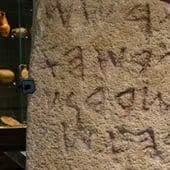
The Ashkar-Gilson Manuscript is a seventh- or eighth-century C.E. manuscript that sheds light on the formation of the Hebrew Bible in the period between the Dead Sea Scrolls and the later codices. Photo: © The Israel Museum, Jerusalem, by Ardon Bar Hama.
What is the oldest Hebrew Bible? That is a complicated question. The Dead Sea Scrolls are fragments of the oldest Hebrew Bible text, while the Aleppo Codex and the Leningrad Codex are the oldest complete versions, written by the Masoretes in the 10th and 11th centuries, respectively. The Ashkar-Gilson Manuscript falls in between the early scrolls and the later codices.
In “Missing Link in Hebrew Bible Formation” in the November/December 2015 issue of Biblical Archaeology Review, Biblical scholar Paul Sanders discusses the role the Ashkar-Gilson Manuscipt had in bridging the gap between the Dead Sea Scrolls and the later Aleppo Codex and Leningrad Codex.
The Dead Sea Scrolls were first discovered by Bedouin in 1947. Over 80,000 scroll fragments that came to be known as the Dead Sea Scrolls were found in 11 caves near the Dead Sea site of Khirbet Qumran. The Dead Sea Scrolls date between 250 B.C.E. and 68 C.E. and represent the largest group of Second Temple Jewish literature ever discovered. The Dead Sea Scrolls contain two types of documents: fragments of the oldest Hebrew Bible texts and writings that—most scholars argue—describe the beliefs and practices of a community of Jews living and writing at the nearby settlement of Qumran.
The Aleppo Codex, the oldest Hebrew Bible that has survived to modern times, was created by scribes called Masoretes in Tiberias, Israel around 930 C.E. As such, the Aleppo Codex is considered to be the most authoritative copy of the Hebrew Bible. The Aleppo Codex is not complete, however, as almost 200 pages went missing between 1947 and 1957.
Interested in the history and meaning of the Dead Sea Scrolls? In the free eBook Dead Sea Scrolls, learn what the Dead Sea Scrolls are and why are they important. Find out what they tell us about the Bible, Christianity and Judaism.
While the Aleppo Codex is the oldest Hebrew Bible, the Leningrad Codex is the oldest complete Hebrew Bible. The Leningrad Codex dates to 1008 C.E. The scribe who penned the Leningrad Codex actually identified himself in two colophons (an inscription containing the title, the scribe’s or printer’s name, and the date and place of composition) at the beginning and end of the text as Samuel ben Jacob, or Samuel son of Jacob. The colophons also identify the place written (Cairo), the person who commissioned it (Mevorak son of Nathaniel) as well as further sale and donation details.
The Ashkar-Gilson Manuscript was purchased by Fuad Ashkar and Albert Gilson (hence the name Ashkar-Gilson) from an antiquities dealer in Beirut, Lebanon in 1972, and some years later, they donated it to Duke University in North Carolina. Based on carbon-14 dating and paleographic analysis, the Ashkar-Gilson Manuscript was dated to sometime between the seventh and eighth centuries C.E., right at the tail end of the so-called “silent era”— an almost 600-year period from the third through eighth centuries, or the time between the oldest Hebrew Bible fragments (the Dead Sea Scrolls) and the oldest complete Hebrew Bible authoritative Masoretic codices.
Was the Ashkar-Gilson Manuscipt the source of the later, authoritative Masoretic traditions? For the answer to this question and more, read the full article “Missing Link in Hebrew Bible Formation” by Paul Sanders as it appears in the November/December 2015 issue of BAR.
BAS Library Members: Read the full article “Missing Link in Hebrew Bible Formation” by Paul Sanders in the November/December 2015 issue of Biblical Archaeology Review.
Not a BAS Library or All-Access Member yet? Join today.
This Bible History Daily feature was originally published on November 1, 2015.
Related reading in Bible History Daily
More on the Dead Sea Scrolls, Aleppo Codex, and Leningrad Codex in the BAS Library
Not a BAS Library or All-Access Member yet? Join today.
Related Posts




Must-Read Free eBooks

Unlock Unlimited Access to the Bible's Past

Unlock Unlimited Access to the Bible's Past
Become an All-Access Member to explore the Bible's rich history. Get Biblical Archaeology Review in print, full online access, and FREE online talks. Plus, enjoy special Travel/Study discounts. Don't miss out—begin your journey today!

You are correct, Wes, in that the method used in interpretations involving related root words can be confusing to those of us not familiar with the Hebrew language. Fortunately the gospel of John 9:7 provides an example that can be easily understood, with the word Siloam being interpreted as meaning “sent forth,” that is ultimately derived from speculation concerning Genesis 49:10 which states:
“The scepter will not depart from Judah, nor the ruler’s staff from between his legs, until Shiloh comes, and to him the submission of peoples.”
In the Babylonian Talmud Tractate Sanhedrin 98bb, it mentions this cryptic reference to the Messiah in the word “shiloh’ as being the Judahite King Hezekiah, perhaps because it is stated that the people ruled by his father on the throne, King Ahaz, had “scorned the waters of Shiloah (Siloam) which flow gently along” (Isaiah 8:6).
Thank y’all for such engaging enlightenments and exchanges. Yes, seriously. Enriches my day immeasurably (and wouldn’t present day measuring instruments fail anyway.)
Dear Joe (and others):
If you wish to read what I have written on the changes to the Patriarch’s lifespans between the Septuagint and the Masoretic (deletion of 1400 years), email me at [email protected] and I will send it to you.
The use of BCE and CE has less to do with science per se and more to do with groups of people or individuals who do not endorse or suggest that they endorse Christianity, for whatever reason. The criterion for such groups and individuals is historical and, for some, religious, more than scientific. As a Jew, I still recognize that, historically, the Western world and more have come to view the year 1 as a huge turning point. But I want a way to refer to it without endorsing the view Jesus was or is the Christ, as I would do using BC Before Christ) and I also want a way to not endorse the view that Jesus or Jesus Christ is Lord in some way, as I would do using AD (the year of our Lord). Christians think he was and is Lord but not Jews, Muslims, agnostics or atheists. Public schools are run by state governments which should not be endorsing any religious view. The entire British public school system has been using BCE and CE for many years. Not just scientists, then, but Jews and scholars in many fields who wish to not endorse Christianity use BCE and CE.
Saul, the article is not on the Greek Bible but the Hebrew Bible. Yes, the LXX translation was done earlier than the Dead Sea Scrolls but the oldest extant complete LXX we have comes from a date later than the Scrolls (the Codex Vaticanus from about 350). But I think there are fragments from the 1st century BCE (within the Scroll period) while some Dead Sea Scroll fragments go back to 250 BCE.
In the end there is some very good news and some not so good news. The good news is this: in many instances the Hebrew text found among the Scrolls is very, very similar to the consonantal text standardized later by the Masoretes. The copy of Isaiah is very much like the copy found in Codex Leningradensis.
The not so good news is that this is not the case with all of the books of the Hebrew Bible. Scholars had long noted, for example, that the Septuagint (Greek) text of the book of Jeremiah was about 15% shorter than the Masoretic text (i.e., it had that many fewer verses/words), and scholars had suspected that it was because the Hebrew version of Jeremiah known to the ancient Greek translators was significantly different from the Masoretic Text. As it turns out, one of the scrolls discovered at Qumran has a Hebrew text of Jeremiah that is closer to that lying behind the Septuagint version than the Masoretic text. 15% is a big difference. Other books of the Septuagint are also strikingly different from the Masoretic text, for example, in the books of Samuel and Kings. It is possible that the Hebrew texts of all these books were in serious flux before the text came to be standardized by the end of the first century. Bart Ehrman
I used to believe in God until I actually read the Bible. I do not deny that Jesus was a real person. I do believe he was misled and brainwashed to believe he was the son of a higher power to cover up the fact of humiliation that his mother was molested Maybe by her father or family member and impregnated as this would have brought much shame and humiliation to the family. so they’re starts the fairy tale story of Jesus Christ. you have to admit it is the most interesting and longest running Fairy Tail ever in short there is no God or Heaven There is no hell it’s just lights out the end. Sure it’s scary to think there is no life after death but the reality is we’re all going to die and there’s nothing we can do about it we all have to take our turn so just accept it and live your best life right now
BC, AD, is right don’t change it cause your worried about feelings, that’s what’s wrong now, got to worry about hurting someone’s feelings, get over it is always been this way, yes I know it’s about evolving but no I do not agree people need there feelings hurt to grow, and be wiser and etc.
So what about life after death experience.Surely there is a God & Angeles.We have millions humans around the world with these testimony.
It is not necessarily wrong to consider the LXX as the oldest “Hebrew” Bible. it was translated by Hebrew scribes for Hebrew people who spoke Greek more than a hundred years prior to Jesus.. The Hebrew language was dying out and this was a valid means to preserve the Scripture.
The content closely matches the Dead Sea Scrolls, whereas the Masoeretic version, copied nearly a millennium after Christ does not match entirely. It has been proven, and I’ve actually verified the differences, that the Masoretic scribes “left out” parts of certain prophecies that linked to Jesus as the Messiah. As well, the ages of the descendants of Shem were shortened by 600 years collectively in the Masoretic text which makes it seem that Shem outlived at least seven generations of his descendants and was alive during the lifetime of Abraham. Why? So that those who did not want to “endorse” Jesus as the Messiah could “prove” that Melkizadek and Shem were one and the same, to whom Abraham gave a tenth. The Levitical priesthood descended from Shem, making Melkizadek in the line of the Levite’s. This was to disqualify Jesus as the Messiah since His lineage was not through the Levite’s.
I’ve read other, albeit non–Biblical, Jewish writings wherein it is admitted that the Jewish leaders knew Jesus was who He said He was, but that they were not willing to give up their control over the Jews. Thus you have Jesus’ parable about the owner of a vineyard who sent his son to check on the workers and they killed the owner’s, knowing who he was. And if you look at how frequently Israel abandoned Adonai, and how they acted toward their Creator, (Just read the second chapter of Jeremiah for some graphic perspectives on how God viewed His chosen people for their idolatry), you’ll certainly be able to see that they knew full well what they were doing in “making errors” in the Masoeric text.
I mis-stated: when I wrote that they were trying to disqualify Jesus as the Messiah, I meant to say that they were using those genealogies to disqualify Jesus as our “High Priest.” according to the order of Melkizadek. (Thus also making it possible to deny Him as Messiah.)