


David’s Sling and an Inscribed Sling Bullet from Hippos
Ancient warfare and the language of combat

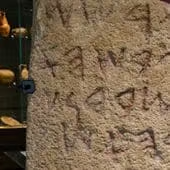
Sling bullet found in Hippos with Greek inscription reading “Learn your lesson!” Courtesy Michael Eisenberg.
A sling bullet inscribed “Learn your lesson!” (Greek ΜΑΘΟΥ) has been found in the ancient city of Hippos (c. second–first centuries BCE), located in the hills east of the Sea of Galilee. This small projectile was launched using a handheld rotating sling, similar to the weapon described for David in his famous showdown with Goliath (1 Samuel 17). Fascinatingly, the Hippos bullet bears a taunt never meant to be read by its target, likening it in some sense to a curse.
Sling bullets were simple but highly effective, and slingers were standard military specialists in the ancient world. A trained slinger could launch a small stone or lead bullet at extreme speed, striking targets at distances of roughly 330 to 985 feet. This made them especially dangerous in combat around hilltop cities like Hippos.

The projectile was recovered approximately 850 feet downslope from the city walls, near the Sussita stream. The terrain around the stream provided a natural approach toward the city’s eastern gate. In this setting, attackers likely advanced uphill along the streambed while defenders occupied elevated positions above. From these heights, slingers could exploit gravity to fire downward and increase the bullet’s impact.
The object is an almond-shaped lead bullet, cast in a two-part mold, weighing 1.33 ounces (likely closer to 1.58 ounces before damage). Across 26 years of excavation at Hippos, 69 sling bullets have been recovered, some decorated with symbols such as scorpions or thunderbolts. However, this is the first inscribed example from the site. Comparable Hellenistic sling bullet inscriptions from other sites include names, military identifiers, or short formulaic taunts like this one, elsewhere “Take this!” or “Receive this!”
The bullet shows clear evidence of use in combat. Impact marks and surface deformation indicate that it struck a solid object at high velocity. The bullet, then, was not a symbolic or unused object, but an actual projectile fired during battle. This begs another question: Why write a message that would not realistically be read by its recipient?
In the biblical account, David’s use of the sling is accompanied by speech. Before striking Goliath, he declares that the outcome will demonstrate divine authority and judgment. Like the Hippos inscription, David’s words frame violence as a form of instruction: Once Goliath is defeated, “the whole world will know that there is a God in Israel” (1 Samuel 17:46–47). While David’s words are spoken aloud and heard in real time, the meaning of ΜΑΘΟΥ inscribed upon the Hippos sling bullet is imagined to be enacted at the moment of contact. Both cases show how ancient accounts of combat attach rhetoric and symbolism to acts of violence.1
The Hippos bullet inscription seems to function less as practical communication and more as a performative or even a quasi-ritual act, embedding intention into the projectile itself. It also likely served a psychological function, building confidence and resolve among those slinging the bullets.
Though separated by time and context, the episode of David and Goliath helps bring the Hippos bullet into sharper relief, and vice versa. The connection between them lies not in a direct historical link, but in shared technologies and enduring military practices. The Hippos find joins a broader body of evidence showing that the sling was a real and widely used military technology in the region over many centuries. In this light, the biblical depiction of sling use reflects a persistent and historically grounded military tradition rather than an isolated or purely literary motif. For its part, the biblical text helps clarify the significance of the inscription, suggesting ancient warfare was not only a matter of weapons and tactics, but also of language, intention, and symbolic action.
Lauren K. McCormick is an assistant editor at Biblical Archaeology Review and a specialist in ancient Near Eastern religions, visual culture, and the Bible. She holds degrees in religion from Syracuse University, Duke University, New York University, and Rutgers University, and completed a postdoctoral fellowship on religion and the public conversation at Princeton University.
- This point is offered as a historical and descriptive observation about two specific cases, rather than a moral endorsement of violence in general, for example with Exodus 20:13 and Proverbs 20:22 in mind.
Become a BAS All-Access Member Now!
Read Biblical Archaeology Review online, explore 50 years of BAR, watch videos, attend talks, and more

Related reading in Bible History Daily
All-Access members, read more in the BAS Library
Not a BAS Library or All-Access Member yet? Join today.
Related Posts



Must-Read Free eBooks




Unlock Unlimited Access to the Bible's Past

Unlock Unlimited Access to the Bible's Past
Become an All-Access Member to explore the Bible's rich history. Get Biblical Archaeology Review in print, full online access, and FREE online talks. Plus, enjoy special Travel/Study discounts. Don't miss out—begin your journey today!

And the tradition continued as shown by messages that were written on bombs by troops in World War II and later. Lt. Col. Jimmy Doolittle attached a medal given to him by Japan with a note saying he was returning it “with interest” to a bomb dropped on Tokyo in April 1942.