


Barnabas: An Encouraging Early Church Leader
Part one of a two-part character study
This is the first of two posts written by Dr. Robin Branch on Barnabas, an early church leader. The blogs are condensed from a longer article by Dr. Branch titled, “Barnabas: Early Church leader and model of encouragement,” In die Skriflig 41.2 (2007): pp. 295-322. To read part two, click here.

Robin Branch posits that Barnabas may have resembled representations of Zeus: middle-aged but physically powerful and muscular man who is both regal and commanding.
Acts presents the evangelizing apostle and church leader Barnabas as a model of integrity and character. Calling him a good man (Acts 11:24), a prophet and teacher (13:1), an apostle (14:14) and one through whom God worked miracles (15:12), Acts loads him with accolades. Acts recounts the times he faced persecution (13:45; 14:19) and risked his life for the name of the Lord Jesus Christ (15:26).
Barnabas believed Saul truly had been converted (9:27), saw the potential of his kinsman John Mark (12:25), and championed them both at different times (11:25-26; 15:36-41). 1 Corinthians 9:6 affirms his character by noting he worked while serving congregations in order not to burden them. The apostles nicknamed him Barnabas, Son of Encouragement (4:36), and it seems like he earned it!
Yet despite the many times Barnabas appears in the Biblical text, he lacks the scholarly attention accorded to his evangelist and writing colleague, Saul/Paul.
According to early traditions that are not recorded in the Bible, Barnabas was taught by Gamaliel and became a follower of Jesus. Among his first converts was Mary, his kinswoman and John Mark’s mother. Barnabas accompanied Jesus during his travels in Galilee and Jesus chose him as one of the Seventy Apostles. Evidently he tried to convert Saul, also Gamaliel’s pupil, but Saul rejected his teaching and chose instead to persecute the new believers.
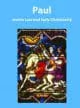
The Bible typically remains silent about physical descriptions. Yet clues provide boundaries for the imagination. On a missionary journey with Paul to Lystra, a miracle takes place—a lame man walks!—and the astonished people call Barnabas Zeus and Paul Hermes, because Paul was the chief speaker (Acts 14:11–13). Busts of Zeus, the supreme ruler of Mount Olympus, depict a middle-aged but physically powerful and muscular man who is both regal and commanding. Perhaps that describes Barnabas.
Acts introduces Barnabas as Joseph, a Levite from Cyprus, with a story about money and giving (Acts 4:36–37). In this first mention of Barnabas, Luke, traditionally regarded as the writer of both Luke and Acts, recounts his generosity: Barnabas sells a field and places the money at the apostles’ feet. This public gesture and his humbleness stand in sharp contrast to the subsequent Lucan example regarding money: the conniving, lying, hording attitude of Ananias and Sapphira (5:1–11).
Read about Paul’s First Missionary Journey through Perga and Pisidian Antioch and explore the route with a web-exclusive slideshow in Bible History Daily.
The text gives no indication that Barnabas’ gift responded to a call from church leadership for money. Unlike other New Testament situations (1 Cor. 16:1, 3), there seems to have been no pressing need for a large financial contribution. Instead, Barnabas’ gesture sparkles with spontaneity and joy. Barnabas gives the gift without stipulations and for the use of the community.
Evidently the field’s sale and the donation of its proceeds put Barnabas in an immediate leadership position, even though he is not part of the original Twelve disciples or a member of the Seven, the Greek-speaking servants of the widows who dealt with the daily distribution of food (Acts 6:1–2, 5).
However, his single act of generosity unquestionably earned him lifelong favor and standing in the community. Through his action, he acknowledges the apostles’ authority and submits to it.
Read “Part II—Barnabas: An Encouraging Early Church Leader.”
 Robin Gallaher Branch is professor of Biblical studies at Victory University (formerly Crichton College) in Memphis, Tennessee, and Extraordinary Associate Professor in the Faculty of Theology at North-West University in Potchefstroom, South Africa. She received her Ph.D. in Hebrew Studies from the University of Texas in Austin in 2000. She was awarded a Fulbright Fellowship for the 2002–2003 academic year to the Faculty of Theology at North-West University. Her most recent book is Jereboam’s Wife: The Enduring Contributions of the Old Testament’s Least-Known Women (Hendrickson, 2009).
This Bible History Daily feature was originally published on November 11, 2013.
Related reading in Bible History Daily:
Paul’s First Missionary Journey through Perga and Pisidian Antioch
All-Access members, read more in the BAS Library:
From Jewish to Gentile: How the Jesus Movement Became Christianity
Why Perga? Paul’s perilous passage through Pisidia
Special Collection: Paul’s Journeys
Not a BAS Library or All-Access Member yet? Join today.
Related Posts



Must-Read Free eBooks


Unlock Unlimited Access to the Bible's Past

Unlock Unlimited Access to the Bible's Past
Become an All-Access Member to explore the Bible's rich history. Get Biblical Archaeology Review in print, full online access, and FREE online talks. Plus, enjoy special Travel/Study discounts. Don't miss out—begin your journey today!

barnabas bible located at turkey
would u read and believe original barnabas bible?
Any writing not contaminated by the Iron rule and extreme censorship of Constantine who destroyed truth for the sake of power would be worthy. The spirital gift of descernment would verify truth from deception which is rampant and staging a comeback through Lucifarian forces being born again
Since Barnabas was from Cyprus, why does the photo imply he looked like Europeans?
I read someone who said that Barnabas was Lazarus. After Jesus resurrected him, the Jewish authorities were not happy that he was a living proof of Jesus’ power and therefore a challenge to their power.
The Cypriot Orthodox Church has a long tradition that Lazarus settled in Cyprus.
I think the Cypriot view is that Lazarus and his sisters were from Cyprus. At some point – after his resurrection – he returned to Cyprus. He lived there as Lazarus.
This author I read said that in order to avoid the Jewish authorities, he went back to Cyprus, but left again for Palestine to be a part of the “Christian” community. To do that he had to change his identity. He was/became Barnabas. That author said he owned property in Cyprus and thus (he and his sisters) had enough wealth to host Jesus and His Disciples.
I didn’t know his earliest name to be Joseph, or that Barnabas is a nickname. So, if he were Lazarus, then that was his birth name, and he took Joseph as his name when he returned to Palestine, and was given the nickname Barnabas by the Faithful. It might have been a way to further hide his identity from the Jewish authorities.
To be clear, I’m not saying that Lazarus was Barnabas, but Cyprus does have a strong relationship with Lazarus.