


Roman Crucifixion Methods Reveal the History of Crucifixion
Crucifixion in Antiquity
What do we know about the history of crucifixion? In the following article, “New Analysis of the Crucified Man,” Hershel Shanks looks at evidence of Roman crucifixion methods as analyzed from the remains found in Jerusalem of a young man crucified in the first century A.D. The remains included a heel bone pierced by a large nail, giving archaeologists, osteologists and anthropologists evidence of crucifixion in antiquity.

Crucifixion in antiquity was a gruesome execution, not really understood until a skeletal discovery in the 1980s that gave new insight into the history of crucifixion. Photo: Courtesy Israel Exploration Journal, Vol. 35, No. 1 (1985)
What do these bones tell us about the history of crucifixion? The excavator of the crucified man, Vassilios Tzaferis, followed the analysis of Nico Haas of Hebrew University-Hadassah Medical School in Jerusalem suggesting Roman crucifixion methods: a contorted position: arms nailed to the crossbeam; legs bent, twisted to one side, and held in place by a single nail that passed through a wooden plaque, through both left and right heel bones, and then into the upright of the cross.
However, when Joseph Zias and Eliezer Sekeles reexamined the remains, looking for evidence of Roman crucifixion methods, they found no evidence that nails had penetrated the victim’s arms; moreover, the nail in the foot was not long enough to have penetrated the plaque, both feet, and the cross. And, indeed, what were previously thought to be fragments of two heel bones through which the nail passed were shown to be fragments of only one heel bone and a long bone. On the basis of this evidence, Zias and Sekeles suggest that the man’s legs straddled the cross and that his arms were tied to the crossbeam with ropes, signifying the method of crucifixion in antiquity.
Literary sources giving insight into the history of crucifixion indicate that Roman crucifixion methods had the condemned person carry to the execution site only the crossbar. Wood was scarce and the vertical pole was kept stationary and used repeatedly. Below, in “New Analysis of the Crucified Man,” Hershel Shanks concludes that crucifixion in antiquity involved death by asphyxiation, not death by nail piercing.
Scholars’ Corner: New Analysis of the Crucified Man
By Hershel Shanks
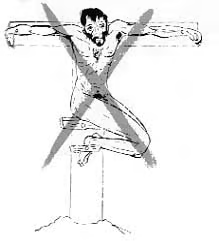
Drawing of the contorted crucifixion position proposed by Vassilios Tzaferis, based on the analysis of Nico Haas, which has since been challenged by Joseph Zias and Eliezer Sekeles. For full caption, see drawing from Israel Exploration Journal 35:1. Photo: Courtesy Israel Exploration Journal, Vol. 20, No. 1–2 (1970)
In our January/February 1985 issue, we published an article about the only remains of a crucified man to be recovered from antiquity (“Crucifixion—The Archaeological Evidence,” BAR, January/February 1985). Vassilios Tzaferis, the author of the article and the excavator of the crucified man, based much of his analysis of the victim’s position on the cross and other aspects of the method of crucifixion on the work of a medical team from Hebrew University-Hadassah Medical School headed by Nico Haas, who had analyzed the crucified man’s bones. In a recent article in the Israel Exploration Journal, however, Joseph Zias, an anthropologist with the Israel Department of Antiquities, and Eliezer Sekeles of Hebrew University-Hadassah Medical School in Jerusalem question many of Haas’s conclusions concerning the bones of the crucified man.a The questions Zias and Sekeles raise affect many of the conclusions about the man’s position during crucifixion.
According to Haas, the nail in the crucified man penetrated both his right and left heel bones, piercing the right heel bone (calcaneum) first, then the left. Haas found a fragment of bone attached to the right heel that he thought was part of the left heel bone (sustentaculum tali). If Haas’s analysis is correct, the two heel bones must have been penetrated by the same nail, and the victim’s legs must have been in a closed position on the cross.
But according to the new analysis of the bones just published in the Israel Exploration Journal, the bone fragment Haas identified as part of the left heel bone was incorrectly identified. “The shape and structure of this bony fragment is of a long bone; it cannot therefore be the left [heel bone],” say the most recent investigators. Their conclusions are confirmed by x-rays, which reveal the varying density, structure and direction of the bones.
Become a BAS All-Access Member Now!
Read Biblical Archaeology Review online, explore 50 years of BAR, watch videos, attend talks, and more

Haas also incorrectly assumed that the nail is seven inches (17–18 cm) long. In fact, the total length of the nail from head to tip is only 4.5 inches (11.5 cm). A wooden plaque less than an inch thick (2 cm) had been punctured by the nail before it passed through the right heel bone. After exiting from the bone, the nail penetrated the cross itself and then bent, probably because it hit a knot. As the new investigators observe, given the length of the nail, “There simply was not enough room for both heel bones and a two centimeter wooden plaque to have been pierced by the nail and affixed to the vertical shaft of the cross. … The nail was sufficient for affixing only one heel bone to the cross.”
In short, only the right heel bone was penetrated—laterally, or sidewise—by the nail. Accordingly, the victim’s position on the cross must have been different from that portrayed by Haas.
The new investigators also dispute Haas’s conclusion that a scratch on the bone of the right forearm (radius) of the victim, just above the wrist, represents the penetration of a nail between the two bones of the forearm. According to Zias and Sekeles, such scratches and indentations are commonly found on ancient skeletal material, including on the right leg bone (fibula) of this man. Such scratches and indentations have nothing to do with crucifixion.
How then was the crucified man attached to the cross?
As the new investigators observe:
“The literary sources for the Roman period contain numerous descriptions of crucifixion but few exact details as to how the condemned were affixed to the cross. Unfortunately, the direct physical evidence here is also limited to one right calcaneum (heel bone) pierced by an 11.5 cm iron nail with traces of wood at both ends.”
According to the literary sources, those condemned to crucifixion never carried the complete cross, despite the common belief to the contrary and despite the many modern reenactments of Jesus’ walk to Golgotha. Instead, only the crossbar was carried, while the upright was set in a permanent place where it was used for subsequent executions. As the first-century Jewish historian Josephus noted, wood was so scarce in Jerusalem during the first century A.D. that the Romans were forced to travel ten miles from Jerusalem to secure timber for their siege machinery.
According to Zias and Sekeles:
“One can reasonably assume that the scarcity of wood may have been expressed in the economics of crucifixion in that the crossbar as well as the upright would be used repeatedly. Thus, the lack of traumatic injury to the forearm and metacarpals of the hand seems to suggest that the arms of the condemned were tied rather than nailed to the cross. There is ample literary and artistic evidence for the use of ropes rather than nails to secure the condemned to the cross.”
According to Zias and Sekeles, the victim’s legs straddled the vertical shaft of the cross, one leg on either side, with the nails penetrating the heel bones. The plaque or plate under the head of the nail, they say, was intended to secure the nail and prevent the condemned man from pulling his feet free.
As Haas correctly suggested, the nail probably hit a knot which bent the nail. However, as Zias and Sekeles reconstruct the removal of the dead man from the cross:
“Once the body was removed from the cross, albeit with some difficulty in removing the right leg, the condemned man’s family would now find it impossible to remove the bent nail without completely destroying the heel bone. This reluctance to inflict further damage to the heel led [to his burial with the nail still in his bone, and this in turn led] to the eventual discovery of the crucifixion.”
Whether the victim’s arms were tied, rather than nailed to the cross is irrelevant to the manner of his dying. As Zias and Sekeles point out:
“Death by crucifixion was the result of the manner in which the condemned man hung from the cross and not the traumatic injury caused by nailing. Hanging from the cross resulted in a painful process of asphyxiation, in which the two sets of muscles used for breathing, the intercostal [chest] muscles and the diaphragm, became progressively weakened. In time, the condemned man expired, due to the inability to continue breathing properly.”
Our website, blog and email newsletter are a crucial part of Biblical Archaeology Society's nonprofit educational mission
This costs substantial money and resources, but we don't charge a cent to you to cover any of those expenses.
If you'd like to help make it possible for us to continue Bible History Daily, BiblicalArchaeology.org, and our email newsletter please donate. Even $5 helps:

Notes
a. “The Crucified Man from Giv‘at ha-Mivtar: A Reappraisal,” Israel Exploration Journal Vol. 35, No. 1 (1985), pp. 22–27.
Zias and Sekeles also note a number of other errors in Haas’s report:
- The victim’s legs were not broken as a final coup de grâce. The break so identified by Haas was postmortem.
- The victim did not have a cleft palate. The upper right canine was not missing, despite Haas’s report to the contrary.
- The wood from which the plaque under the nail head was made was olive wood, not acacia or pistacia, as Hans suggested.
- The wood fragments attached to the end of the nail were too minute to be analyzed. Haas suggested the vertical shaft of the cross was olive wood. This is possible, but unlikely.
Related reading in Bible History Daily
Rare Evidence for Roman Crucifixion Found in Second-Century Britain
All-Access members, read more in the BAS Library
Not a BAS Library or All-Access Member yet? Join today.
“New Analysis of the Crucified Man” by Hershel Shanks first appeared in Biblical Archaeology Review, November/December 1985. It was first reprinted in BHD, September 2012.
Related Posts

Sep 22
Jesus and the Cross
Aug 31
Josephus and Jesus

Jul 26
The Staurogram

Apr 16
How Was Jesus Crucified



Must-Read Free eBooks

Unlock Unlimited Access to the Bible's Past

Unlock Unlimited Access to the Bible's Past
Become an All-Access Member to explore the Bible's rich history. Get Biblical Archaeology Review in print, full online access, and FREE online talks. Plus, enjoy special Travel/Study discounts. Don't miss out—begin your journey today!

how did they crucify Jesus?
Jesus was struck by 400-600 Romans on the left cheek prior to being cast out the prophesied Shiloam Water Gate (yes, it is accurate & provable, contrary to Masonic Conspiracy against Christianity prevalent in “scholarship”) & Jesus’ face was swollen many times until the left eye was shut & concealed. With 1 right eye from the Cross, fulfilling prophecy, He wastaken across a then existent Water Gate bridge & crucified at the Kidron & Hinom Valley just as the Bible tells us (Revelation 11:8)), for which reason Masons worship Lucifer with an open Left Eye and run interference on the true location of the cross just across the Kidron Valley north of En Rogel on Mt. Olivet, just south of the fissure that runs east-west through Olivet, where in the blood moon reddish darkness Jesus just north of the Kidron & Hinom Valley Juncture saw Judas hang himself. It was far deeper in the valleys then as compared to after 70 A.D. ff.
Jesus was crucified in the shape of an Alef. If we were to raise the Alef א by 90 degrees, so that the Vav ו would stand as a vertical, we will see Christ crucified. His right wrist being nailed “palm up”, His left wrist being nailed “palm down”. Jesus’ left side, being the exposed side to be pierced by the spear. This position was itself causing “His bones (to be) out of joint” (Psalm 22:14). The left wrist, normally being bound by the Tefillin, is normally wrapped to form the word “Shaddai” (Almighty), which word represents the nation: Israel. The right hand, elbow down, represents the King Messiah as the same King who is YHVeH, the Right Hand of Power (Matthew 26:64), who — as its governor –carries the nations of the Earth (Psalm 22:27-28; Isaiah 40:15). The fulfilling of prophecy is unmistakable then and now.
All of the arguments and counter-arguments regarding the method of an alleged man named Jeshua Ben Joseph and his manner of execution are confused and missing the point. It’s an argument about what shape the horrible idol desecrating the holy place should take; cross or stake, etc. Also, references to English translations of the Latin Vulgate, from Greek texts translated from Aramaic; prove nothing. Commentators attempt to sound intelligent by referring to ‘Greek texts’, but only prove to anyone with real knowledge how little they know. What is the ‘bible’? What language did Jeshua speak?
Especially ludicrous are the commentators reference to a ‘christian church’, as though there is a thing called the ‘Christian Church’ or one universal church. Do they mean Christendom? It is especially silly, when one considers that what the writer is actually referring to is the church that they believe is the correct one, his or her preferred organization, the ‘chosen ones’. When in actuality, the only and first ‘christian church’ is the one founded by Rome and ruled over by the one Pontifex Maximus, ironically the current Caesar, from the spiritual lineage of the killers of Jeshua. Even a cursory glance at history confirms that the Romans produced the Latin Vulgate, the first ‘bible’. It was the Roman Catholic Church that was the first institutionalized ‘christian church’. Every extant ‘christian’ organization that exist today is simply an off-shoot of that original body. The symbol of the cross (an idol), which ‘christians’ so fervently worship and defend unto death as the icon of their faith, was promulgated by the Roman Catholics, as was all the other occult imagery and idolatry. The cross is apparently the very instrument of their lord and saviour’s torture. How bizarre a thing it is that devotees of a man, purported to be a god, the God, in the flesh on earth, would choose as the symbol of their faith, their saviour’s very instrument of torture. Especially bizarre when one considers that the symbol of the cross predates the ‘christian’ era by many centuries and was used by so-called pagan people in their spiritual or occult rites, Babylon and Egypt to name a couple.
The Romans tortured and executed dissidents and displayed their mutilated bodies for all to see, thus psychologically repressing any would be free-thinkers from breaking rank. The Roman Catholic Church (from the lineage of Babylon) or Babylon the Great, Mother of the Harlots, mentioned in the book of Revelation, are doing exactly the same thing to their modern followers (slaves). They use the image of the mutilated human corpse impaled on the cross, to further their occult domination on the psychology of repressed mankind. They are showing you in plain sight what ‘christianity’ really is, the extension of the Roman Empire, a powerful system of world domination. With the cross image, they remind you how they co-opted the teachings and legacy of the real Jeshua Ben Joseph, the authentic Jesus Christ in order to create their own evil power structures. With the symbol of the bloody corpse on the cross, they’re saying in effect: “Look you suckers, we tortured and murdered your saviour and then co-opted everything he taught and distorted it into a religion. Now you follow us as we psychologically control you, so that we can get you to do what ever we say, including murder each other and fight wars over meaningless religious dogma.’
They threw it right in our faces and people buy the image of their murdered saviour it as though it’s some kind of magic symbol to be revered, like the image itself has power to save. Images that are given reverence are called IDOLS. Can anyone seriously picture Jesus or his actual followers in the first century bending themselves before a pagan symbol of any kind, let alone one with the image of Jesus mutilated body on it? It would be psychotic to think so.
Sad but true, if you revere the ‘cross’, this dead, miserable travesty, then It’s your horrible, grisly ‘golden calf’. Every time you look to it, you ‘impale Christ over and over again.’ Then you argue about the shape of the instrument of torture and death of your saviour like it matters, like it’s actually virtuous. How misguided. This is my verbal ‘whip of ropes’ for all armchair academics exchanging metaphorical currency in the Father’s house.
Kev, your words are relevant and bang on!! Imagine a world where people wore necklaces of a sniper rifle to keep the memory of JFK alive, let alone start a slogan “come to the rifle to be saved”. Or how many people were executed by hanging? If Jeshua Ben Joseph had been hung would the symbol of Christendom be a noose? If he had been beheaded like his cousin John the Baptizer would Christians be honoring ( worshipping ) a broad sword?
I have asked these questions out loud for years only to be labelled a heretic. Thank you for your for your commentary. However as to the point as your “whip of ropes” was – do you have a positive spin on the historical importance of Rabbi Jeshua Ben Joseph. Do you think his existence, his teachings and example are of any use to us today? Even H.G Wells acknowledges that no one person who has ever existed has had more influence on human history than Jesus. Your thoughts?
If you have seen the nail through the heel, it is quite clear that it was never in a solid wooden cross upright. It may have hit a knot and bent but it certainly could never have been in far enough to support anything. Especially when there was a 2 cm plaque after the nail had gone through the heel bone. If an upright was used repeatedly and they used a nail each time in a new hole, the upright isn’t going to last very long. It’s not a little panel pin that goes in it is a thick roughly made piece of iron.
The most extensive study ever done on the words often translated “cross” and “crucify,” Crucifixion in Antiquity, was done and published in 2011. It examined how these words were used in antiquity up to the 1st century AD. It concluded that the ancient languages (that is, until the end of the 1st c. AD) had no specialized word for “cross” or “crucify” but only ones signifying “pole” or “suspend (on a pole).” Any who try to use drawings and texts from the 2nd c. AD onward are not using evidence from the correct time period to ascertain how our Lord Jesus Christ died, but are anachronistically misusing later evidence. The evidence from the 1st c. AD and before is conclusive that Jesus died by being suspended from a pole.
A summary of what was studied and the conclusions of the study: “Content of The Book … ancient Greek literature from Homer until the turn of the first century of the Common Era is studied … also … the Jewish authors Flavius Josephus and Philo Judaeus … ancient Latin literature will be studied, and the latter time limit is the same as it was with the Greek literature … the ancient Hebrew and Aramaic literature of the Old Testament times will be studied, as well as ancient translations of these texts … Answers to the Basic Questions of the Investigation: First, what is the ancient-pre-Christian-terminology of crucifixion? The answer is that there was no such terminology. There was only a terminology of suspension … Α σταυρός is a pole in the broadest sense. It is not the equivalent of a ‘cross’ … crux and patibulum are not used in the sense ‘cross or standing bare pole’ and ‘crossbeam’ … crux … refers to a standing pole … the ancient languages (i.e., Greek, Latin, Hebrew/Aramaic) lacked a special term for ‘crucifixion’ … antiquity had no special terminology for crucifixion because there was no particular punishment called ‘crucifixion’ … what can be said about the punishment that the terms describe? … it comprises various acts of suspension … The frequent and colorful depictions of crucifixions and the death of Jesus mentioned in the previous chapter [which are those common in Christendom] are essentially without support in the studied text material” (Crucifixion in Antiquity by Gunnar Samuelsson pp. 35, 303-306, Tubingen, Germany, Mohr Siebeck, 2011).
Also, as to Thomas’ words in John 20:25, “Unless I see the nail marks in his hands and put my finger where the nails were, and put my hand into his side, I will not believe it” (NIV), this is easily harmonized with the above evidence. Either his hands (which term included his wrists according to how the word “hands” was used in antiquity) were nailed one to each side of the stake, or the word “nails” is used collectively to refer to nails as being the instrument used to attach Jesus to the stake.
As to using in worship or as an ornament, a representation of the instrument by which our Lord Jesus died, such usage would be foolish or even idolatrous, as has been commented by others. But to discuss its true shape, and to establish it as being a stake or pole, is not pointless, but is to remove any seeming validity whatsoever from the usage of the cross in Christian worship or ornamentation.
I believe that information from the 2nd century AD and later, that is used to show the shape of the instrument used to execute Jesus Christ, is not necessarily valid from a Biblical standpoint. The reason is that, from then onward, many of those claiming to follow Jesus Christ deviated from his teaching and the teaching of his apostles.
Jesus himself predicted this departure from what he taught, which came to be known as “the apostasy.” The parable that he gave that is sometimes called, “the Wheat and the Weeds,” predicted the coming time when this apostasy would take place, when imitation Christians, called “weeds” in the parable, would appear alongside real Christians (Matthew 13:24-30, 36-43). Jesus said this would begin “while his men were sleeping” (vs 25; NIV), referring to the men working for ‘the owner’ of the sown field (vs 27). Jesus identified himself as the sower and owner of the field (vs 37), so “his men” would be his disciples, especially the 12 apostles. And Jesus was not just talking about a small minority of Christians becoming apostate, for in vss 28, 29 he indicated that there would be so many imitations that any attempt to uproot them would result in the uprooting of true Christians also, This would be due to the great number of imitation Christians intertwined with the genuine ones.
The apostle Paul also predicted this occurrence in 2 Thessalonians 2:1-12, in his prophecy about “the man of lawlessness” (vs 3; NIV), calling this development in vs 3 “the apostasy” (NAS), or, “the falling away” (AS), and saying that this would serve as “a deluding influence so that they will believe what is false” (vs 11; NAS). As to when this would take place, Paul wrote, “For the secret power of lawlessness is already at work; but the one who now holds it back will continue to do so till he is taken out of the way” (vs 7: NIV).
So who were these ‘sleeping men’ in Matthew 13 whose sleeping allowed imitation Christians to spring up amidst the true Christians? Who was the “one who holds it back,” that is, who held back the “deluding influence” that eventually caused Christians ‘to believe what is false’? Paul himself tells us in his words spoken to Christian elders in the city of Ephesus, where he said, “I know that when I’m gone savage wolves will come among you and not spare the flock. Indeed, some of your own men will arise and distort the truth in order to lure the disciples into following them” (Acts 20:29, 30; NIV). So Paul himself was a factor in holding back Christians from ‘falling away’ from Christianity.
A reading of the Christian Scriptures, especially the book of Acts, will show that the 12 apostles of Jesus Christ, as well as the apostle Paul, were, as a composite body, ‘the one holding it back [i.e., the falling away]’ (2 Thess 2:7). They led the Christian congregation as shepherds and protected it from divisive influences. After Paul and all the other apostles had all died, by around 100 AD, this ‘one holding it back’ would then be gone and the apostasy could bloom. This is what Jesus meant in his parable of the Wheat and the Weeds when he said this time of imitation Christianity would begin “while his men [the apostles] were sleeping,” for sleeping is a common metaphor for death in the Christian Scriptures (John 10:11-14).
The last surviving apostle, John, wrote that he was living in the last hour, the final period of the pure Christian congregation, for around 98 AD he wrote, “Children, it is the last hour; and just as you heard that antichrist is coming, even now many antichrists have appeared; from this we know that it is the last hour. They went out from us, but they were not really of us; for if they had been of us, they would have remained with us; but they went out, so that it would be shown that they all are not of us” (1 John 2:18, 19; NAS). He identifies it being “the last hour” because of the presence of many former Christians who were working against Christ, being “antichrists” who, while professing to be Christians, were actively working against true Christianity. This is exactly what Jesus and Paul had predicted. And by calling his time period, “the last hour,” John was not saying the end of the present age would be upon him immediately (for that was over 1900 years ago), but that it was the last hour of the undefiled Christian congregation.
Hegesippus, a church historian living in the latter half of the 2nd century AD, wrote the following about what happened in the early part of that century, going along with what we have stated: “The Church up to that time [the reign of Trajan, 98-117 AD] had remained a pure and uncorrupted virgin, since, if there were any that attempted to corrupt the sound norm of the preaching of salvation, they lay until then concealed in obscure darkness. But when the sacred college of apostles had suffered death in various forms, and the generation of those that had been deemed worthy to hear the inspired wisdom with their own ears had passed away, then the league of godless error took its rise as a result of the folly of heretical teachers, who, because none of the apostles was still living, attempted henceforth, with a bold face, to proclaim, in opposition to the preaching of the truth, the ‘knowledge which is falsely so-called’ [1Tim 6:20]“ (“Ecclesiastical History” by Eusebius 3, 32, 7 & 8 in A Select Library of the Nicene and Post-Nicene Fathers of the Christian Church: Second Series edited by Philip Schaff, New York, Charles Scribner’s Sons, 1904).
So from this it can be seen that any evidence of Christian teaching and practice from the 2nd century AD onward would have to be verified as divinely-approved by being in line with 1st century Christian teaching and practice. If contrary to such, it would be suspect. And such would be the case for usage of a two-beamed cross in Christian matters.
Very interesting worth studying
I can’t imagine anything we concern ourselves with in our lives matters.
Continuously put in taking into consideration the
various things that people deal with each and every moment
is just really important, as no other woman will face your life for any
of us. Personally I think that citizens have to be a whole lot
more grounded. Research is terrific, however, so much of whatever you might know about is so abstract.
Having a cup of tea is a zen activity that takes one back again to the present minute.
We must become more in the here and now, without being confused by existence and the episodes we encounter every day.