


Roman Crucifixion Methods Reveal the History of Crucifixion
Crucifixion in Antiquity
What do we know about the history of crucifixion? In the following article, “New Analysis of the Crucified Man,” Hershel Shanks looks at evidence of Roman crucifixion methods as analyzed from the remains found in Jerusalem of a young man crucified in the first century A.D. The remains included a heel bone pierced by a large nail, giving archaeologists, osteologists and anthropologists evidence of crucifixion in antiquity.

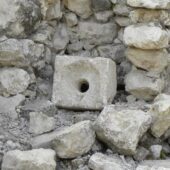
Crucifixion in antiquity was a gruesome execution, not really understood until a skeletal discovery in the 1980s that gave new insight into the history of crucifixion. Photo: Courtesy Israel Exploration Journal, Vol. 35, No. 1 (1985)
What do these bones tell us about the history of crucifixion? The excavator of the crucified man, Vassilios Tzaferis, followed the analysis of Nico Haas of Hebrew University-Hadassah Medical School in Jerusalem suggesting Roman crucifixion methods: a contorted position: arms nailed to the crossbeam; legs bent, twisted to one side, and held in place by a single nail that passed through a wooden plaque, through both left and right heel bones, and then into the upright of the cross.
However, when Joseph Zias and Eliezer Sekeles reexamined the remains, looking for evidence of Roman crucifixion methods, they found no evidence that nails had penetrated the victim’s arms; moreover, the nail in the foot was not long enough to have penetrated the plaque, both feet, and the cross. And, indeed, what were previously thought to be fragments of two heel bones through which the nail passed were shown to be fragments of only one heel bone and a long bone. On the basis of this evidence, Zias and Sekeles suggest that the man’s legs straddled the cross and that his arms were tied to the crossbeam with ropes, signifying the method of crucifixion in antiquity.
Literary sources giving insight into the history of crucifixion indicate that Roman crucifixion methods had the condemned person carry to the execution site only the crossbar. Wood was scarce and the vertical pole was kept stationary and used repeatedly. Below, in “New Analysis of the Crucified Man,” Hershel Shanks concludes that crucifixion in antiquity involved death by asphyxiation, not death by nail piercing.
Scholars’ Corner: New Analysis of the Crucified Man
By Hershel Shanks

Drawing of the contorted crucifixion position proposed by Vassilios Tzaferis, based on the analysis of Nico Haas, which has since been challenged by Joseph Zias and Eliezer Sekeles. For full caption, see drawing from Israel Exploration Journal 35:1. Photo: Courtesy Israel Exploration Journal, Vol. 20, No. 1–2 (1970)
In our January/February 1985 issue, we published an article about the only remains of a crucified man to be recovered from antiquity (“Crucifixion—The Archaeological Evidence,” BAR, January/February 1985). Vassilios Tzaferis, the author of the article and the excavator of the crucified man, based much of his analysis of the victim’s position on the cross and other aspects of the method of crucifixion on the work of a medical team from Hebrew University-Hadassah Medical School headed by Nico Haas, who had analyzed the crucified man’s bones. In a recent article in the Israel Exploration Journal, however, Joseph Zias, an anthropologist with the Israel Department of Antiquities, and Eliezer Sekeles of Hebrew University-Hadassah Medical School in Jerusalem question many of Haas’s conclusions concerning the bones of the crucified man.a The questions Zias and Sekeles raise affect many of the conclusions about the man’s position during crucifixion.
According to Haas, the nail in the crucified man penetrated both his right and left heel bones, piercing the right heel bone (calcaneum) first, then the left. Haas found a fragment of bone attached to the right heel that he thought was part of the left heel bone (sustentaculum tali). If Haas’s analysis is correct, the two heel bones must have been penetrated by the same nail, and the victim’s legs must have been in a closed position on the cross.
But according to the new analysis of the bones just published in the Israel Exploration Journal, the bone fragment Haas identified as part of the left heel bone was incorrectly identified. “The shape and structure of this bony fragment is of a long bone; it cannot therefore be the left [heel bone],” say the most recent investigators. Their conclusions are confirmed by x-rays, which reveal the varying density, structure and direction of the bones.
Become a BAS All-Access Member Now!
Read Biblical Archaeology Review online, explore 50 years of BAR, watch videos, attend talks, and more

Haas also incorrectly assumed that the nail is seven inches (17–18 cm) long. In fact, the total length of the nail from head to tip is only 4.5 inches (11.5 cm). A wooden plaque less than an inch thick (2 cm) had been punctured by the nail before it passed through the right heel bone. After exiting from the bone, the nail penetrated the cross itself and then bent, probably because it hit a knot. As the new investigators observe, given the length of the nail, “There simply was not enough room for both heel bones and a two centimeter wooden plaque to have been pierced by the nail and affixed to the vertical shaft of the cross. … The nail was sufficient for affixing only one heel bone to the cross.”
In short, only the right heel bone was penetrated—laterally, or sidewise—by the nail. Accordingly, the victim’s position on the cross must have been different from that portrayed by Haas.
The new investigators also dispute Haas’s conclusion that a scratch on the bone of the right forearm (radius) of the victim, just above the wrist, represents the penetration of a nail between the two bones of the forearm. According to Zias and Sekeles, such scratches and indentations are commonly found on ancient skeletal material, including on the right leg bone (fibula) of this man. Such scratches and indentations have nothing to do with crucifixion.
How then was the crucified man attached to the cross?
As the new investigators observe:
“The literary sources for the Roman period contain numerous descriptions of crucifixion but few exact details as to how the condemned were affixed to the cross. Unfortunately, the direct physical evidence here is also limited to one right calcaneum (heel bone) pierced by an 11.5 cm iron nail with traces of wood at both ends.”
According to the literary sources, those condemned to crucifixion never carried the complete cross, despite the common belief to the contrary and despite the many modern reenactments of Jesus’ walk to Golgotha. Instead, only the crossbar was carried, while the upright was set in a permanent place where it was used for subsequent executions. As the first-century Jewish historian Josephus noted, wood was so scarce in Jerusalem during the first century A.D. that the Romans were forced to travel ten miles from Jerusalem to secure timber for their siege machinery.
According to Zias and Sekeles:
“One can reasonably assume that the scarcity of wood may have been expressed in the economics of crucifixion in that the crossbar as well as the upright would be used repeatedly. Thus, the lack of traumatic injury to the forearm and metacarpals of the hand seems to suggest that the arms of the condemned were tied rather than nailed to the cross. There is ample literary and artistic evidence for the use of ropes rather than nails to secure the condemned to the cross.”
According to Zias and Sekeles, the victim’s legs straddled the vertical shaft of the cross, one leg on either side, with the nails penetrating the heel bones. The plaque or plate under the head of the nail, they say, was intended to secure the nail and prevent the condemned man from pulling his feet free.
As Haas correctly suggested, the nail probably hit a knot which bent the nail. However, as Zias and Sekeles reconstruct the removal of the dead man from the cross:
“Once the body was removed from the cross, albeit with some difficulty in removing the right leg, the condemned man’s family would now find it impossible to remove the bent nail without completely destroying the heel bone. This reluctance to inflict further damage to the heel led [to his burial with the nail still in his bone, and this in turn led] to the eventual discovery of the crucifixion.”
Whether the victim’s arms were tied, rather than nailed to the cross is irrelevant to the manner of his dying. As Zias and Sekeles point out:
“Death by crucifixion was the result of the manner in which the condemned man hung from the cross and not the traumatic injury caused by nailing. Hanging from the cross resulted in a painful process of asphyxiation, in which the two sets of muscles used for breathing, the intercostal [chest] muscles and the diaphragm, became progressively weakened. In time, the condemned man expired, due to the inability to continue breathing properly.”
Our website, blog and email newsletter are a crucial part of Biblical Archaeology Society's nonprofit educational mission
This costs substantial money and resources, but we don't charge a cent to you to cover any of those expenses.
If you'd like to help make it possible for us to continue Bible History Daily, BiblicalArchaeology.org, and our email newsletter please donate. Even $5 helps:

Notes
a. “The Crucified Man from Giv‘at ha-Mivtar: A Reappraisal,” Israel Exploration Journal Vol. 35, No. 1 (1985), pp. 22–27.
Zias and Sekeles also note a number of other errors in Haas’s report:
- The victim’s legs were not broken as a final coup de grâce. The break so identified by Haas was postmortem.
- The victim did not have a cleft palate. The upper right canine was not missing, despite Haas’s report to the contrary.
- The wood from which the plaque under the nail head was made was olive wood, not acacia or pistacia, as Hans suggested.
- The wood fragments attached to the end of the nail were too minute to be analyzed. Haas suggested the vertical shaft of the cross was olive wood. This is possible, but unlikely.
Related reading in Bible History Daily
Rare Evidence for Roman Crucifixion Found in Second-Century Britain
All-Access members, read more in the BAS Library
Not a BAS Library or All-Access Member yet? Join today.
“New Analysis of the Crucified Man” by Hershel Shanks first appeared in Biblical Archaeology Review, November/December 1985. It was first reprinted in BHD, September 2012.
Related Posts

Sep 22
Jesus and the Cross

Aug 31
Josephus and Jesus

Jul 26
The Staurogram

Apr 16
How Was Jesus Crucified



Must-Read Free eBooks

Unlock Unlimited Access to the Bible's Past

Unlock Unlimited Access to the Bible's Past
Become an All-Access Member to explore the Bible's rich history. Get Biblical Archaeology Review in print, full online access, and FREE online talks. Plus, enjoy special Travel/Study discounts. Don't miss out—begin your journey today!

This article is woefully out of date and reflects my thoughts and research on the topic in the mid 1980’s. In the world of science ‘absolute truth lasts but ca 20 yrs…and I’ve changed over the years.
I see that there are still folks who want to change history and historical evidence to fit their belief system; by that I mean that there is obviously commentary by Jehovah’s Witnesses here who want to make stauros = stake to fit the teaching of the Watchtower Society. The closer to the springhead, the purer the water. A 20th century revision by a religious sect, versus historical evidence all the way back to the 1st century (e.g. cross image on the wall after the Vesuvius eruption, etc) is just wishful thinking or anti-Christian bias.
The so-called presence of a cross in the cities destroyed by Mt. Vesuvius, are highly questionable. One such cross is now believed to be traces left by a set of bookshelves, Another looks strangely like the Egyptian ankh worshiped for centuries before Christ or possibly a so-called Staurogram which is a symbol found on a Herodian coin prior to Jesus’s execution. Archaeologists believe the cross didn’t appear till several hundred years later among (apostate) Christians. Jehovah’s Witnesses stopped using the cross in their magazines in the 1920s as outside evidence and improved Bible scholarship suggested strongly that the cross was actually a pole or stake. And most certainly in either case was not to be revered.or worshiped.
There are a number of images from the first and second centuries of Jesus or others on a cross not a stake. The JWs have this utterly unsupported idea of a stake based entirely on the earlier meaning of the word Stauros. It’s a bit like saying that a cupboard can only ever mean a board for cups! Words grow and expand their meaning. Or have a range of meaning. In this instance there is NO evidence that a stake was used , there is evidence that a cross was used. Thee is no reason to claim that the bible says stake it doesn’t, and that Jesus dieted on a stake …he didn’t. LOOK AT THe EVIDENCE!
Everything written with relation to the crucifixion is unreliable. No one was taking notes, and no one foresaw that a world religion would spring from the followers of the victim, therefore everything is anecdotal.
Also we have no real idea when Christianity ‘took off.’ when was the first century, was it after Constantine’s so called conversion. Did he say this is going to be the first, second, or third century, after Christ?
How would he determine from where to start and when exactly Jesus had died, unless the Romans were keeping records of every terrorist they executed, which I doubt, I would imagine that they would have been treated as non existent, in a way that the Japanese treated the soldiers who were not officer class.
I think is was many centuries later that someone had an idea to start the ball rolling.
The whole business of religion is born from the desires and beliefs and ambitions of human beings, there is nothing supernatural about it.
How anyone in their right minds in this day and age, believes in a being who is going to reward or punish them in some after life beggar’s belief.
Absolutely. Say the word ‘Christian’ to the Nazarenes, and they woudn’t have had a clue what you were talking about. The whole Christian concept is Pauline. The resurection the virgin birth, is all down to Saul/Paul. The word messiah meant king, and Jesus’ cousin, John the Baptist, was not determining a future supernatural individual, but a Jewish saviour as prophesised in the Tanakh. The Nicean Creed determined what was added to the pentateuch – the four Canonical Gospels, which contain even more errors than Donald Trump’s schlep lies. The whole deal is fake news….but that does not mean there is no God (whatever exactly that means).
Skepticism is also a faith in human reasoning, therefore not believing is also a religion which can’t be proved or disproved. So I choose
faith in Jesus is, though I can’t prove the resurrection I choose to believe it.
Throughout history different types of crosses have been used for crucifixions. The type used to hang Jesus on is irrelevant. That He was crucified for the sins of the world says it all.
So, based on this single exemplar, the decision is made that this is “the way” Romans crucified people. It doesn’t seem like enough evidence to say that.
Crucifixion was almost certainly a function of locality & resources. There may have been many different methods of this execution depending upon how readily available wood was, how many men were carrying out the sentence, who the condemned was. Crassus crucified some 6,000 slaves after the Third Servile War, known as the Spartacus Revolt, along the Appian Way in 71 BC. I’m sure there were many different variations used; it is unlikely that they would have utilized the tremendous amount of wood required to carry out the sentence on slaves. It also wasn’t very long ago that most people – archaeologists even – believed that the nails were used on or through the hands. We now know this would never have held up and more than likely the nails were applied through the radii or arm bones.
Can you pick up your own body weight with your hands? Of course you can, then why wouldn’t the hands hold when nailed to a cross? The skin on ancient hands would be much thicker, due to the life they lived, a rough life, an external life in sun and rain, cold and heat. The idea that the hand structure was too weak to hold you on a cross is ludicrous. Try reading about industrial accidents involving the hands, how a ring on a finger could easily suspend an idividual in the air for hours and that’s one hand!
Read Psalm 22:21 ! Horns of the unicorn are in the prophecy. Then consider Justin Marters’ description of the cross having 5 horns. There are only 3 first and second century century descriptions of what a crucifix looked like, two of them plainly state that there were horns on the cross that presumably the victim was pierced by then tied to the cross! In Sparticus days 6000 crucified men would have taken a large amount of iron smiths and a good bit of cash. The details of what a crucifixion entailed were forgotten when Constantine retired the practice. Some 1300 years later by an order to create a new translation post haste was given by King James. These transfers kept notes and when one reads these it becomes clear they struggled with whether Christ was tied or peged or nailed to the timbers. The final choice is written but the 1st 2nd and possibly 3rd century written descriptions had not been discovered yet. 6000 men with only 4 iron nails would be a staggering 12,000 pieces. I believe the use of horns or even acacia thorns are more likely. 2 of the descriptions suggest a 5th horn was placed into the rectum of the victim. Had this been the case holding ones self up off of such a seat would become more torcherous as the joints of the wrist, elbows, and shoulders separated. The human torso would become, as some speculate, up to 9 inches longer. Possibly causing the piercing of vital organs such as the heart! Resulting in death. The fact that the Roman’s did not remove there victims from the crucifix after death but left them to rot and be scavenged by animals makes the burial of one crucified rare. Only Jews were removed before sunset by permission of sympathetic Roman rulers. When the men on either side had there legs broken to hurry there death before sunset on the Sabbath. One can safely surmize they were also Jews. Christ’ body was spared this by prophecy fullfilled.
The Ransom—God’s Greatest Gift
How did Jehovah provide the ransom? He sent one of his perfect spirit sons to the earth. But Jehovah did not send just any spirit creature. He sent the one most precious to him, his only-begotten Son. (Read 1 John 4:9, 10.) Willingly, this Son left his heavenly home.
Jehovah performed a miracle when he transferred the life of this Son to the womb of Mary. By means of God’s holy spirit, Jesus was born as a perfect human and was not under the penalty of sin.—Luke 1:35.
How could one man serve as a ransom for many, in fact, millions of humans? Well, how did humans numbering into the millions come to be sinners in the first place? Recall that by sinning, Adam lost the precious possession of perfect human life. Hence, he could not pass it on to his offspring. Instead, he could pass on only sin and death. Jesus, whom the Bible calls “the last Adam,” had a perfect human life, and he never sinned. (1 Corinthians 15:45) In a sense, Jesus stepped into Adam’s place in order to save us. By sacrificing, or giving up, his perfect life in flawless obedience to God, Jesus paid the price for Adam’s sin. Jesus thus brought hope to Adam’s offspring.—Romans 5:19; 1 Corinthians 15:21, 22.
https://www.jw.org/en/jehovahs-witnesses/memorial/
Daniel says
“Archaeology is a fine science, however, interpretation is often very subjective. For certain Christ was nailed to the tree, whatever the form. John (Lazarus) writes in the gospel of John: John 20:25
So the other disciples told him, “We have seen the Lord.” But he said to them, “Unless I see in his hands the print of the nails, and place my finger in the mark of the nails, and place my hand in his side, I will not believe.”
In the Old Testament, the book of Psalms says Psalm 22:16
Yea, dogs are round about me; a company of evildoers encircle me; they have pierced my hands and feet—
As much as this archaeological note says about crucifixion, it also ignores the biblical account of Christ’s wounds, implying in a deliberate way that the historical and prophetic accounts were in error or hyperbole. This is very bad hermeneutics and poorer historical regards for the text of the Bible.”
Learn some Hebrew. The phrase is “Like a Lion they are at my hands and feet” not unlike American saying of ” The dogs were nippin at my heel” Like a Lion is properly spelled
Kaf Aleph Resh Yud. If it was pierced it would spell the word Ku Resh Ayin VaV. Some Chrisitian apologists say that the Yud in lion should have been a VaV but was shortened by scribal error. Hence the word would be pierced but omit the fact that their is no Aleph if your looking to define it as pierced nor an the requisite Ayin which is part of the word pierced.
omnis traductor traditor every translator is a traitor
Sorry, no Messianic prophecy here.