


Roman Crucifixion Methods Reveal the History of Crucifixion
Crucifixion in Antiquity
What do we know about the history of crucifixion? In the following article, “New Analysis of the Crucified Man,” Hershel Shanks looks at evidence of Roman crucifixion methods as analyzed from the remains found in Jerusalem of a young man crucified in the first century A.D. The remains included a heel bone pierced by a large nail, giving archaeologists, osteologists and anthropologists evidence of crucifixion in antiquity.

Crucifixion in antiquity was a gruesome execution, not really understood until a skeletal discovery in the 1980s that gave new insight into the history of crucifixion. Photo: Courtesy Israel Exploration Journal, Vol. 35, No. 1 (1985)
What do these bones tell us about the history of crucifixion? The excavator of the crucified man, Vassilios Tzaferis, followed the analysis of Nico Haas of Hebrew University-Hadassah Medical School in Jerusalem suggesting Roman crucifixion methods: a contorted position: arms nailed to the crossbeam; legs bent, twisted to one side, and held in place by a single nail that passed through a wooden plaque, through both left and right heel bones, and then into the upright of the cross.
However, when Joseph Zias and Eliezer Sekeles reexamined the remains, looking for evidence of Roman crucifixion methods, they found no evidence that nails had penetrated the victim’s arms; moreover, the nail in the foot was not long enough to have penetrated the plaque, both feet, and the cross. And, indeed, what were previously thought to be fragments of two heel bones through which the nail passed were shown to be fragments of only one heel bone and a long bone. On the basis of this evidence, Zias and Sekeles suggest that the man’s legs straddled the cross and that his arms were tied to the crossbeam with ropes, signifying the method of crucifixion in antiquity.
Literary sources giving insight into the history of crucifixion indicate that Roman crucifixion methods had the condemned person carry to the execution site only the crossbar. Wood was scarce and the vertical pole was kept stationary and used repeatedly. Below, in “New Analysis of the Crucified Man,” Hershel Shanks concludes that crucifixion in antiquity involved death by asphyxiation, not death by nail piercing.
Scholars’ Corner: New Analysis of the Crucified Man
By Hershel Shanks
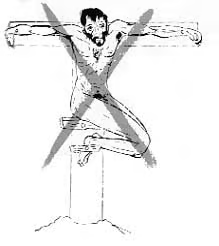
Drawing of the contorted crucifixion position proposed by Vassilios Tzaferis, based on the analysis of Nico Haas, which has since been challenged by Joseph Zias and Eliezer Sekeles. For full caption, see drawing from Israel Exploration Journal 35:1. Photo: Courtesy Israel Exploration Journal, Vol. 20, No. 1–2 (1970)
In our January/February 1985 issue, we published an article about the only remains of a crucified man to be recovered from antiquity (“Crucifixion—The Archaeological Evidence,” BAR, January/February 1985). Vassilios Tzaferis, the author of the article and the excavator of the crucified man, based much of his analysis of the victim’s position on the cross and other aspects of the method of crucifixion on the work of a medical team from Hebrew University-Hadassah Medical School headed by Nico Haas, who had analyzed the crucified man’s bones. In a recent article in the Israel Exploration Journal, however, Joseph Zias, an anthropologist with the Israel Department of Antiquities, and Eliezer Sekeles of Hebrew University-Hadassah Medical School in Jerusalem question many of Haas’s conclusions concerning the bones of the crucified man.a The questions Zias and Sekeles raise affect many of the conclusions about the man’s position during crucifixion.
According to Haas, the nail in the crucified man penetrated both his right and left heel bones, piercing the right heel bone (calcaneum) first, then the left. Haas found a fragment of bone attached to the right heel that he thought was part of the left heel bone (sustentaculum tali). If Haas’s analysis is correct, the two heel bones must have been penetrated by the same nail, and the victim’s legs must have been in a closed position on the cross.
But according to the new analysis of the bones just published in the Israel Exploration Journal, the bone fragment Haas identified as part of the left heel bone was incorrectly identified. “The shape and structure of this bony fragment is of a long bone; it cannot therefore be the left [heel bone],” say the most recent investigators. Their conclusions are confirmed by x-rays, which reveal the varying density, structure and direction of the bones.
Become a BAS All-Access Member Now!
Read Biblical Archaeology Review online, explore 50 years of BAR, watch videos, attend talks, and more

Haas also incorrectly assumed that the nail is seven inches (17–18 cm) long. In fact, the total length of the nail from head to tip is only 4.5 inches (11.5 cm). A wooden plaque less than an inch thick (2 cm) had been punctured by the nail before it passed through the right heel bone. After exiting from the bone, the nail penetrated the cross itself and then bent, probably because it hit a knot. As the new investigators observe, given the length of the nail, “There simply was not enough room for both heel bones and a two centimeter wooden plaque to have been pierced by the nail and affixed to the vertical shaft of the cross. … The nail was sufficient for affixing only one heel bone to the cross.”
In short, only the right heel bone was penetrated—laterally, or sidewise—by the nail. Accordingly, the victim’s position on the cross must have been different from that portrayed by Haas.
The new investigators also dispute Haas’s conclusion that a scratch on the bone of the right forearm (radius) of the victim, just above the wrist, represents the penetration of a nail between the two bones of the forearm. According to Zias and Sekeles, such scratches and indentations are commonly found on ancient skeletal material, including on the right leg bone (fibula) of this man. Such scratches and indentations have nothing to do with crucifixion.
How then was the crucified man attached to the cross?
As the new investigators observe:
“The literary sources for the Roman period contain numerous descriptions of crucifixion but few exact details as to how the condemned were affixed to the cross. Unfortunately, the direct physical evidence here is also limited to one right calcaneum (heel bone) pierced by an 11.5 cm iron nail with traces of wood at both ends.”
According to the literary sources, those condemned to crucifixion never carried the complete cross, despite the common belief to the contrary and despite the many modern reenactments of Jesus’ walk to Golgotha. Instead, only the crossbar was carried, while the upright was set in a permanent place where it was used for subsequent executions. As the first-century Jewish historian Josephus noted, wood was so scarce in Jerusalem during the first century A.D. that the Romans were forced to travel ten miles from Jerusalem to secure timber for their siege machinery.
According to Zias and Sekeles:
“One can reasonably assume that the scarcity of wood may have been expressed in the economics of crucifixion in that the crossbar as well as the upright would be used repeatedly. Thus, the lack of traumatic injury to the forearm and metacarpals of the hand seems to suggest that the arms of the condemned were tied rather than nailed to the cross. There is ample literary and artistic evidence for the use of ropes rather than nails to secure the condemned to the cross.”
According to Zias and Sekeles, the victim’s legs straddled the vertical shaft of the cross, one leg on either side, with the nails penetrating the heel bones. The plaque or plate under the head of the nail, they say, was intended to secure the nail and prevent the condemned man from pulling his feet free.
As Haas correctly suggested, the nail probably hit a knot which bent the nail. However, as Zias and Sekeles reconstruct the removal of the dead man from the cross:
“Once the body was removed from the cross, albeit with some difficulty in removing the right leg, the condemned man’s family would now find it impossible to remove the bent nail without completely destroying the heel bone. This reluctance to inflict further damage to the heel led [to his burial with the nail still in his bone, and this in turn led] to the eventual discovery of the crucifixion.”
Whether the victim’s arms were tied, rather than nailed to the cross is irrelevant to the manner of his dying. As Zias and Sekeles point out:
“Death by crucifixion was the result of the manner in which the condemned man hung from the cross and not the traumatic injury caused by nailing. Hanging from the cross resulted in a painful process of asphyxiation, in which the two sets of muscles used for breathing, the intercostal [chest] muscles and the diaphragm, became progressively weakened. In time, the condemned man expired, due to the inability to continue breathing properly.”
Our website, blog and email newsletter are a crucial part of Biblical Archaeology Society's nonprofit educational mission
This costs substantial money and resources, but we don't charge a cent to you to cover any of those expenses.
If you'd like to help make it possible for us to continue Bible History Daily, BiblicalArchaeology.org, and our email newsletter please donate. Even $5 helps:

Notes
a. “The Crucified Man from Giv‘at ha-Mivtar: A Reappraisal,” Israel Exploration Journal Vol. 35, No. 1 (1985), pp. 22–27.
Zias and Sekeles also note a number of other errors in Haas’s report:
- The victim’s legs were not broken as a final coup de grâce. The break so identified by Haas was postmortem.
- The victim did not have a cleft palate. The upper right canine was not missing, despite Haas’s report to the contrary.
- The wood from which the plaque under the nail head was made was olive wood, not acacia or pistacia, as Hans suggested.
- The wood fragments attached to the end of the nail were too minute to be analyzed. Haas suggested the vertical shaft of the cross was olive wood. This is possible, but unlikely.
Related reading in Bible History Daily
Rare Evidence for Roman Crucifixion Found in Second-Century Britain
All-Access members, read more in the BAS Library
Not a BAS Library or All-Access Member yet? Join today.
“New Analysis of the Crucified Man” by Hershel Shanks first appeared in Biblical Archaeology Review, November/December 1985. It was first reprinted in BHD, September 2012.
Related Posts

Sep 22
Jesus and the Cross

Aug 31
Josephus and Jesus

Jul 26
The Staurogram

Apr 16
How Was Jesus Crucified



Must-Read Free eBooks



Unlock Unlimited Access to the Bible's Past

Unlock Unlimited Access to the Bible's Past
Become an All-Access Member to explore the Bible's rich history. Get Biblical Archaeology Review in print, full online access, and FREE online talks. Plus, enjoy special Travel/Study discounts. Don't miss out—begin your journey today!

Archaeology is a fine science, however, interpretation is often very subjective. For certain Christ was nailed to the tree, whatever the form. John (Lazarus) writes in the gospel of John: John 20:25
So the other disciples told him, “We have seen the Lord.” But he said to them, “Unless I see in his hands the print of the nails, and place my finger in the mark of the nails, and place my hand in his side, I will not believe.”
In the Old Testament, the book of Psalms says Psalm 22:16
Yea, dogs are round about me; a company of evildoers encircle me; they have pierced my hands and feet—
As much as this archaeological note says about crucifixion, it also ignores the biblical account of Christ’s wounds, implying in a deliberate way that the historical and prophetic accounts were in error or hyperbole. This is very bad hermeneutics and poorer historical regards for the text of the Bible.
Dan Moran.
Personally, I have no theological interest in the method of crucifixion used in the case of Jesus or any other cases, but it is an interesting question of historical trivia and anatomy. It is fortunate indeed that the Romans abandoned crucifixion when they began to worship someone who had been crucified (not that cruel punishments in general were abandoned; witness the abuses of the Inquisition, or being hanged, drawn, AND quartered). But it is unfortunate for historians that so little contemporary literary or archeological evidence has been found: one heel bone out of all the millions of victims in Roman history!
One reason may be that most of the victims were Greco-Roman pagans, who generally practiced cremation, not burial, in the case of the few victims returned to a family for funerary rituals. However, many, perhaps the majority, were deliberately left on the cross (or stake) to decompose, adding to the indignity AND the warning to passers-by. Governments have often considered executed criminals to be unworthy of their culture’s usual funeral rituals (see Electra in Greek drama; and even today, while executed criminals in most states are returned to their families for burial, Texas confiscates the bodies and buries them in a prison graveyard with only numbered markers, indexed in the prison archives; and hanged criminals in the Old West and the Caribbean were often allowed to rot on the gallows). Any heel bones or wrist bones with nails would have been scattered over the landscape by scavenging animals in this case.
The Biblical accounts are not contemporary, since they are based upon recollections, possibly second- or third-hand recollections, and may have been edited for theological reasons (as other parts of the text have been shown to be edited). One possible theological reason may have to do with Constantine’s vision of the cross in the sky before the battle which won him the Imperium. A common optical artifact when looking at an extremely bright point or small disk is a pair of apparent “rays” at 90 degree intervals, so Constantine probably saw a cross when a small meteor passed over some distance away. If the “cross” shape was ONE of the common forms of the execution stake, and the Christians around him pointed out that Jesus was crucified, then as Emperor, Constantine could have influenced the bishops to promote the common impression of a pair of boards at right angles, which MAY or may NOT have been the historical fact of the matter, in order to reinforce his confidence in his vision.
As for nails in both hands and feet, it is not inconceivable that the single-stake method could have involved nailing (after tying with ropes) the hands above the head on opposite sides of the stake, OR EQUALLY, nailing (after tying) the hands to a crossbar. Both methods would add increased pain (which the Romans obviously wanted), and both would produce four nail wounds. Lacking a theological reason to prefer one over the other (for this PARTICULAR victim), we can leave it up to individual imagination, and artistic license in making paintings or sculptures. It belongs in the same category as what race Jesus was; as the song says, little children (and adults) imagine a Jesus the same race as themselves, to increase their feeling of love and connection to their Savior. Likewise, whatever fits your feeling about how much He suffered for you is appropriate; but watch out if you find yourself imagining more and more gruesome pain, because you may actually be imagining yourself torturing someone ELSE!
Not the Crucifixion but the Resurrection was the demonstration of His, and although hidden by our doubts, our oneness with the Father.
Scholarship’s radical swing to looking at everything, but the Bible for its data has become quite ridiculous. Whether one believes the Bible to be a supernatural document is quite different than using it as an historical source when it comes to these things. Obviously, since the writers are familiar with crucifixion in the first century and give some vivid details of Christ’s crucifixion, one might have a look at that as a piece of evidence for what may have occurred in some or all cases. Perhaps, nailing one’s hands/wrists were a way of making sure the criminal did not squirm out of the ropes? Bring the data together. Ignoring major pieces of it because of a bias against usi9ng ANY biblical data is absurd.
Considering the scarcity of large local timber, why use nails at all. It seems as though nails being continuously driven in and removed would have weakened the vertical timber to such an extent that after a few crucifixions it would no longer sustain the weight of a man. Rope ties would be a better choice. However, in the case of Jesus, nails were used as a means to ridicule his message of his resurrection; a form of mockery.
The son of David (Son Of God) we are told had no characteristics that we should desire him. He is to be the final KING. King Saul was the tallest of Jewish men. King David was very small in stature. Christ being a direct descendant os David and having no physical reason to be desired would not be tall. I believe Nicodemus was an average sized man and climbed the tree to see Jesus Christ because his head was much lower than all the people in the crowd. The shroud of Turin’ image has been reported to be 5’7″ inches in height. The separation of the joints described as a result of crucifixion can be as much as 9 inches. The Lord Jesus Christ was about 4′ 9″ inches tall. Can you see why he was scoffed at by the religious elite.
According to Josephus at the destruction of Jerusalem in 70 AD the crosses were as thick as a forest, therefore there was no scarcity of wood as this article suggested.
Steven your assertion that it was a simple up right post is not born out from early first century records. Seneca [37AD] stated criminals were crucified with arms outstretched, the Way Jesus said that Peter would be Crucified.
John-I am strongly inclined to believe that Jesus died on a stake based on evidence presented by other writers above. Roman historian, Seneca the Younger’s words were actually “stretch out your arms on the gibbet”. At times the gibbet was a vertical stake, called in Latin “crux simplex”. This was the simplest available construction for torturing and killing. The Greek words used for Jesus execution in the NT were “stauros” (a stake or pole)or “xy’lon”(tree or stake). So whatever other methods of execution were used in the 1st century, the Bible says Jesus died on a stake. Peter himself said at I Peter 2:24 that Jesus died on a tree (xy’lon, tree or stake). Bibles translations that translate either of these words as “cross” are probably influenced by the adoption of the pagan cross by later apostate Christianity. As already mentioned it has become a thing of idolatrous worship. I shudder to think what people would wear around their neck if Jesus had been hanged.
From a purely logical perspective that accepts that the Biblical account’s details are accurate and genuine, it HAD to be a crossbeam that was carried to the place of crucifixion. The length and weight of a single beam would have been virtually impossible for any human to carry. Do the math.
A 2×4 of hardwood such as oak was easily big enough and strong enough, but an entire cross made of oak would have been horribly heavy.
Since we don’t know the girth, length or type of wood, we most go by the Bible’s statement that it was a stake or pole that Jesus dragged to the place of execution. They eventually had to enlist help for him.
The Roman method of a public hanging was on a post, not a cross.