


How the Serpent in the Garden Became Satan
Adam, Eve and the serpent in the Garden of Eden
Shawna Dolansky
June 23, 2026
191 Comments
566102 views
Introduced as “the most clever of all of the beasts of the field that YHWH God had made,” the serpent in the Garden of Eden is portrayed as just that: a serpent. Satan does not make an appearance in Genesis 2–3, for the simple reason that when the story was written, the concept of the devil had not yet been invented. Explaining the serpent in the Garden of Eden as Satan would have been as foreign a concept to the ancient authors of the text as referring to Ezekiel’s vision as a UFO (but Google “Ezekiel’s vision” now, and you’ll see that plenty of people today have made that connection!). In fact, while the word satan appears elsewhere in the Hebrew Bible/Old Testament, it is never a proper name; since there is no devil in ancient Israel’s worldview, there can’t yet have been a proper name for such a creature.
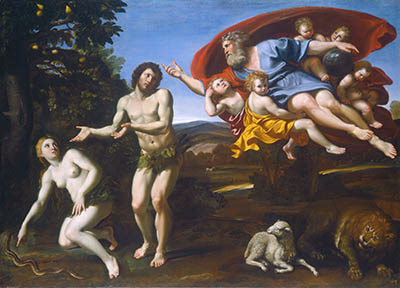
Depicted here are God the Father, cherubim, angels, Adam, Eve and the serpent in the Garden of Eden in Domenichino’s painting The Rebuke of Adam and Eve (1626). Photo: Patrons’ Permanent Fund, National Gallery of Art.
The noun satan, Hebrew for “adversary” or “accuser,” occurs nine times in the Hebrew Bible: five times to describe a human military, political or legal opponent, and four times with reference to a divine being. In Numbers 22, the prophet Balaam, hired to curse the Israelites, is stopped by a messenger from Israel’s God YHWH, described as “the satan” acting on God’s behalf. In Job, “the satan” is a member of God’s heavenly council—one of the divine beings, whose role in Job’s story is to be an “accuser,” a status acquired by people in ancient Israel and Mesopotamia for the purposes of particular legal proceedings.
In Job’s case, what’s on trial is God’s assertion that Job is completely “blameless and upright” vs. the satan’s contention that Job only behaves himself because God has rewarded him. God argues that Job is rewarded because he is good, and not good because he is rewarded. The satan challenges God to a wager that if everything is taken away from poor Job, he won’t be so good anymore, and God accepts. Though a perception of “the satan” as Satan would make this portrait of God easier to swallow, the story demonstrates otherwise; like Yahweh’s messenger in Numbers 22, this satan acts on YHWH’s instructions (and as a result of God’s braggadocio) and is not an independent force of evil.
In Zechariah 3, the prophet describes a vision of the high priest Joshua standing in a similar divine council, also functioning as a tribunal. Before him stand YHWH’s messenger and the satan, who is there to accuse him. This vision is Zechariah’s way of pronouncing YHWH’s approval of Joshua’s appointment to the high priesthood in the face of adversarial community members, represented by the satan. The messenger rebukes the satan and orders that Joshua’s dirty clothing be replaced, as he promises Joshua continuing access to the divine council. Once again, the satan is not Satan who we read about in the New Testament.
The word satan appears only once without “the” in front of it in the entire Hebrew Bible: in 1 Chronicles 21:1. Is it possible that we finally have Satan here portrayed? 1 Chronicles 21 parallels the story of David’s census in 2 Samuel 24, in which God orders David to “go number Israel and Judah” and then punishes king and kingdom for doing so. The Chronicler changes this story, as he does others, to portray the relationship between God and David as uncompromised; he writes that “a satan stood up against Israel and he provoked David to number Israel” (1 Chronicles 21:6–7; 27:24). Although it is possible to read “Satan” here instead of “a satan” (Hebrew uses neither uppercase letters, nor indefinite articles, e.g., “a”), nothing else in this story or in any texts for another 300 years indicates that the idea of an evil prince of darkness exists in the consciousness of the Israelites.
If there’s no Satan in the Hebrew Bible, how does the serpent in the garden become Satan?
The worldview of Jewish readers of Genesis 2–3 profoundly changed in the centuries since the story was first written. After the canon of the Hebrew Bible closed,1 beliefs in angels, demons and a final apocalyptic battle arose in a divided and turbulent Jewish community. In light of this impending end, many turned to a renewed understanding of the beginning, and the Garden of Eden was re-read—and re-written—to reflect the changing ideas of a changed world. Two separate things happened and then merged: Satan became the proper name of the devil, a supernatural power now seen to oppose God as the leader of demons and the forces of evil; and the serpent in the Garden of Eden came to be identified with him. While we begin to see the first idea occurring in texts two centuries before the New Testament, the second won’t happen until later; the serpent in the Garden is not identified with Satan anywhere in the Hebrew Bible or New Testament.
The concept of the devil begins to appear in second and first centuries B.C.E. Jewish texts. In 1 Enoch, the “angel” who “led Eve astray” and “showed the weapons of death to the children of men” was called Gadreel (not Satan). Around the same time, the Wisdom of Solomon taught that “through the devil’s envy death entered the world, and those who are on his side suffer it.” Though this may very well be the earliest reference to Eden’s serpent as the devil, in neither text, nor in any document we have until after the New Testament, is satan clearly understood as the serpent in Eden. At Qumran, though, Satan is the leader of the forces of darkness; his power is said to threaten humanity, and it was believed that salvation would bring the absence of Satan and evil.
By the first century C.E., Satan is adopted into the nascent Christian movement, as ruler over a kingdom of darkness, an opponent and deceiver of Jesus (Mark 1:13), prince of the devils and opposing force to God (Luke 11:15–19; Matthew 12:24–27; Mark 3:22–23:26); Jesus’ ministry puts a temporary end to Satan’s reign (Luke 10:18) and the conversion of the gentiles leads them from Satan to God (Acts 26:18). Most famously, Satan endangers the Christian communities but will fall in Christ’s final act of salvation, described in detail in the book of Revelation.
But curiously, although the author of Revelation describes Satan as “the ancient serpent” (Revelation 12:9; 20:2), there is no clear link anywhere in the Bible between Satan and the serpent in the garden. The ancient Near Eastern combat myth motif, exemplified in the battle between Marduk and Tiamat in Enuma Elish and Baal and Yam/Mot in ancient Canaan, typically depicted the bad guy as a serpent. The characterization of Leviathan in Isaiah 27 reflects such myths nicely:
On that day YHWH will punish
With his hard and big and strong sword
Leviathan the fleeing serpent,
Leviathan the twisted serpent,
And he will kill the dragon that is in the sea.
So the reference in Revelation 12:9 to Satan as “the ancient serpent” probably reflects mythical monsters like Leviathan rather than the clever, legged, talking creature in Eden.
In the New Testament, Satan and his demons have the power to enter and possess people; this is what is said to have happened to Judas (Luke 22:3; John 13:27; cf. Mark 5:12–13; Luke 8:30–32). But when Paul re-tells the story of Adam and Eve, he places the blame on the humans (Romans 5:18; cf. 1 Corinthians 15:21–22) and not on fallen angels, or on the serpent as Satan. Still, the conflation begged to be made, and it will seem natural for later Christian authors—Justin Martyr, Tertullian, Cyprian, Irenaeus and Augustine, for example—to assume Satan’s association with Eden’s talking snake. Most famously, in the 17th century, John Milton elaborates Satan’s role in the Garden poetically, in great detail in Paradise Lost. But this connection is not forged anywhere in the Bible.
 Shawna Dolansky is Adjunct Research Professor and Instructor in the program in Religion at the College of Humanities, Carleton University in Ottawa, Ontario. She coauthored the well-known The Bible Now (Oxford Univ. Press, 2011) with Richard Friedman.
Notes
1. The book of Daniel was the latest book to be included in the Hebrew Bible/Old Testament and dates to about 162 B.C.E.
This Bible History Daily feature was originally published on April 8, 2016.
Related reading in Bible History Daily
All-Access members, read more in the BAS Library
Not a BAS Library or All-Access Member yet? Join today.
Related Posts

Oct 29
The Golden Calf


Must-Read Free eBooks

Unlock Unlimited Access to the Bible's Past

Unlock Unlimited Access to the Bible's Past
Become an All-Access Member to explore the Bible's rich history. Get Biblical Archaeology Review in print, full online access, and FREE online talks. Plus, enjoy special Travel/Study discounts. Don't miss out—begin your journey today!

The author of the page is an Jewish atheist Shawna Dolansky identifies culturally and ethnically as Jewish, though she has described her personal spiritual and theological belief as an atheist. How can one trust the opinion of one who believes all theist faith in God is a myth? I know of no atheist Christian but I have heard of many atheist Jews. Clearly Satan is real as he uses the deceived to pervert the WORD of God. Why have a atheist as an Associate Professor of Religion? There is no atheist religion but they atheist are drawn to attack primary Judeo-Christian religion does prove Satan has deceived them.
Revelation 12:9 And the great dragon was cast out, that old serpent, called the Devil, and Satan, which (deceiveth) the whole world: he was cast out into the earth, and his angels were cast out with him.
So the reference in Revelation 12:9 to Satan as “the ancient serpent” probably reflects mythical monsters like Leviathan rather than the clever, legged, talking creature in Eden.
Maybe we should take the Bible for what it actually said and believe that Satan is “the ancient serpent” otherwise the Holy Spirit is made out to be a liar! According to scripture that is/was the character and nature of Satan –the ancient serpent, the devil. It was/is the Holy Spirit that wrote the books in the first place. The author says “probably reflects” which really inspires confidence in her conclusions. It is interesting to note that nowhere do we find the serpent speaking to Eve from up in a tree! Nowhere is the fruit referred to as an apple. It should be noted that “the Ancient serpent—Satan” didn’t not respond to the Lord God when his punishment was handed down. If he was “at war” with the Lord God then we would’ve expected a defense. He didn’t respond but obeyed what the Lord God had spoken. Why? Because He has never been a threat to the Lord God! Lets take the Bible for what it says! It says that the Lord God created him and with a cunning nature. We read that from the beginning he was/is a murderer and a liar—-which is part of his nature.
My spouse and I stumbled oer here different web page and thought
I might check things out. I like what I ssee so now i
am following you. Look forward to finding out about your web page for a
second time.
You are lost.
I feel this is one of the most important info for me. And i am glad reading your article.
However wanna commentary on few common issues, The
sitte taste is ideal, the articles is actually excellent : D.
Excellent job, cheers
It would not be strange that man’s understanding of Satan clarified over time. Even our understanding of God has clarified over the same time. There is no question as to Satan’s nature as a cosmic deceiver. A being has emerged whose trademark is cunning deception Genesis 3 style. Manly P. Hall wrote “”I hereby promise the Great Spirit Lucifuge, Prince of Demons, that each year I will bring unto him a human soul to do with as it may please him.” So this being is also served by men who choose to serve him. He displays the same patience and cunning we saw in the temptation of Jesus when he retreated to resume at a more “opportune time.”