


Roman Sanctuary Hidden in “Cave of the Women”
Archaeologists discover a “Lady” and 120 inscriptions in the darkness
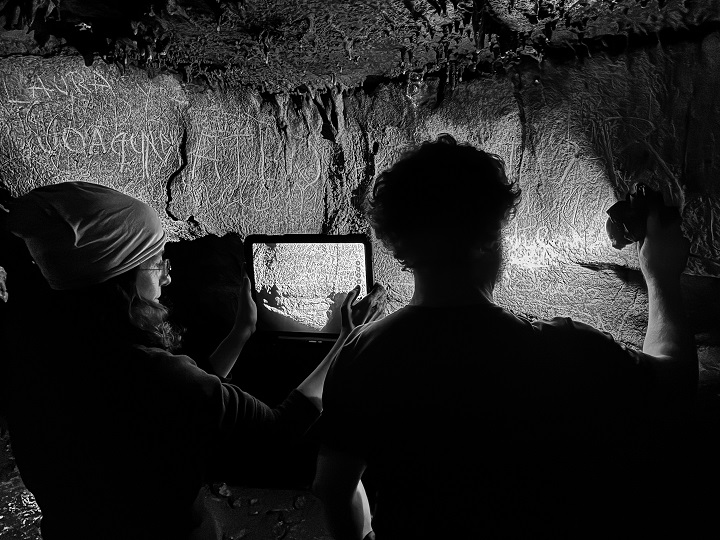
Archaeologists examining wall inscriptions inside Cova Dones in Valencia, Spain. Credit: ArcheoSymbol Group and the University of Alicante.
Recent discoveries at Cova Dones, in Spain’s province of Valencia, offer a fascinating glimpse into Roman religious practice, and potentially women-centered worship. Archaeologists have identified around 120 Latin inscriptions dating primarily to the first and second centuries CE, several of which invoke a goddess called Domina, “Lady,” while feminine names and objects associated with textile production add further evidence of women’s presence. According to the University of Alicante, the 120 inscriptions make Cova Dones (“Cave of the Women”) the largest known collection of Latin inscriptions in a cave-sanctuary found anywhere in the Roman Empire.

Inscription and modern digital tracings of the words domina votum, involving a “Lady” and a “vow.” Credit: ArcheoSymbol Group and the University of Alicante.
The inscriptions occur on the walls and ceiling of a chamber that is more than 650 feet inside the cave. In 2024, a coin from the reign of Emperor Claudius was found wedged in the low cieling of this chamber. The floor contains small natural pools that collect water from underground galleries, and, more recently, researchers posit that that these pools were used by visitors for depositing offerings (perhaps not so different from the modern impulse to throw coins in a well).
The combination of inscriptions and objects is evidence for a form of Roman religion quite different from the image provided by monumental temples to major urban gods. Cova Dones was a local sacred place, with its own distinctive history extending back thousands of years. Over 100 Paleolithic paintings have been found elsewhere in this cave. Roman visitors seem to have entered a holy subterranean environment, addressed a deity through inscriptions, and left physical offerings in the cave’s water and crevices. Devotion was expressed through small, personal acts, contrasting with more public forms of cultic practice, for example seen at nearby temples in the city of Valentia.


Two bronze rings located on the floor of the sanctuary. Credit: ArcheoSymbol Group and the University of Alicante.
In one chamber deep inside the cave, several inscriptions contain feminine names. The sanctuary has also yielded numerous spindle whorls, artifacts traditionally associated with women. Together with inscriptions invoking the goddess “Lady,” these discoveries raise the possibility that women were prominent participants in the religious activity that took place in this chamber, potentially dedicated to a goddess.
For readers of the Bible, the first and second centuries CE represent the period of Christianity’s early expansion across the Roman world. The religious practices identified at Cova Dones belong to the same broad Mediterranean world the earliest Christians inhabited, providing hypothetical background for biblical texts like Acts 17 (where Paul encounters the religious culture of Athens and its “unknown god”) and the wider missionary context of Acts. Early Christians were proclaiming their message within a landscape already filled with shrines, sanctuaries, sacred landscapes, and varied claims about the gods.
With much of the cave still awaiting detailed study and many of the inscriptions still awaiting translation, work is set to continue at Cova Dones in the coming seasons.
Lauren K. McCormick is an assistant editor at Biblical Archaeology Review and a specialist in ancient Near Eastern religions, visual culture, and the Bible. She holds degrees in religion from Syracuse University, Duke University, New York University, and Rutgers University, and completed a postdoctoral fellowship on religion and the public conversation at Princeton University.
Become a BAS All-Access Member Now!
Read Biblical Archaeology Review online, explore 50 years of BAR, watch videos, attend talks, and more

Related reading in Bible History Daily
All-Access members, read more in the BAS Library
Not a BAS Library or All-Access Member yet? Join today.
Related Posts



Must-Read Free eBooks


Unlock Unlimited Access to the Bible's Past

Unlock Unlimited Access to the Bible's Past
Become an All-Access Member to explore the Bible's rich history. Get Biblical Archaeology Review in print, full online access, and FREE online talks. Plus, enjoy special Travel/Study discounts. Don't miss out—begin your journey today!
