


World’s Oldest Shipwreck Discovered
Archaeologists make a big splash off the coast of Turkey
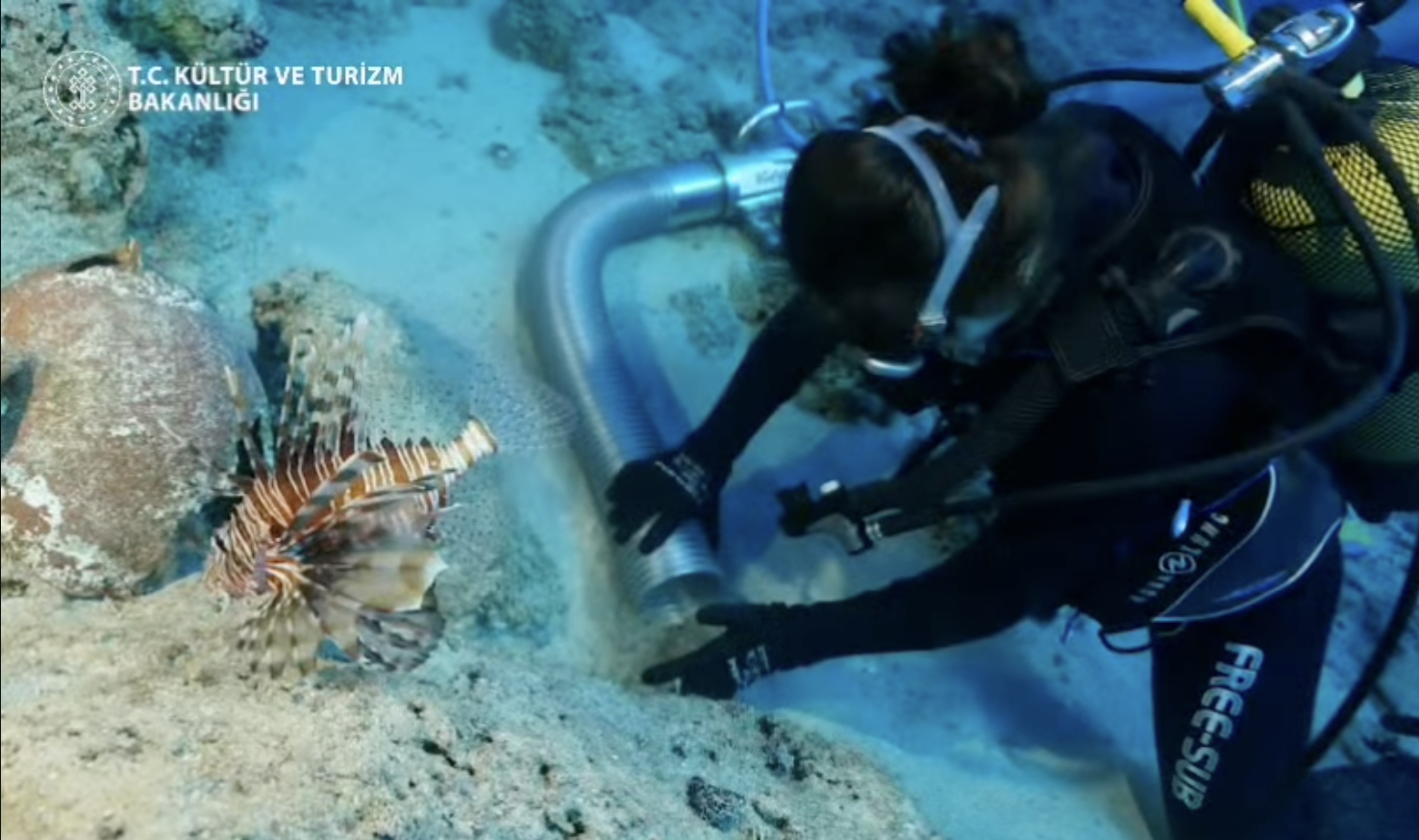
Underwater archaeologist excavating the shipwreck off the coast of Kekova in southwest Turkey. Courtesy Turkish Ministry of Culture and Tourism.
Remains of what appears to be the world’s oldest shipwreck have been found near the island of Kekova, off the southwest coast of Turkey. A team led by Hakan Öniz of Akdeniz University unearthed more than 30 Early Bronze Age amphorae (storage jars) and three stone anchors that date back 4,700 years. The announcement was made on social media by Mehmet Nuri Ersoy, Turkey’s Minister of Culture and Tourism.
One amphora has nine different markings and two holes on its body, which Ersoy relays may have been used to churn cheese or butter, perhaps even by the sailors on board. However, the majority of the amphorae were likely used for storing and transporting olive oil or wine. Even after thousands of years underwater, residues of the original contents were still found on the interior surfaces of the amphorae and are now being analyzed by archaeologists.
The clay from the amphorae indicate they were probably produced in the Jordan Valley. Adding yet further to the intrigue, similar amphorae are found in Egypt, Troy, and Crete. In fact, that shape of the amphorae is the primary diagnostic that was used to date the shipwreck. The more than 30 amphorae shed light on early trade in the eastern Mediterranean, both of storage vessels and the goods they carried.
Though the wooden ship itself has not survived, its general outline can be reconstructed by the position of the amphorae and anchors found on the seafloor. The team suggests the ship started its voyage somewhere on the east coast of the Mediterranean and may have capsized en route to Troy or Crete.
Prior to this discovery, the evidence for Early Bronze Age maritime trade in this region was mostly indirect: from ports, ancient texts, and traded goods (especially storage jars). The only find like the Kekova shipwreck is the shipwreck found off the Greek island of Dokos, with jars dating to around 2200 BCE (Kekova’s date to c. 2675 BCE).
Lauren K. McCormick is an assistant editor at Biblical Archaeology Review and a specialist in ancient Near Eastern religions, visual culture, and the Bible. She holds degrees in religion from Syracuse University, Duke University, New York University, and Rutgers University, and completed a postdoctoral fellowship on religion and the public conversation at Princeton University.
Become a BAS All-Access Member Now!
Read Biblical Archaeology Review online, explore 50 years of BAR, watch videos, attend talks, and more

Related reading in Bible History Daily
Two-Thousand-Year-Old Shipwreck Discovered Off Turkish Coast
All-Access members, read more in the BAS Library
Not a BAS Library or All-Access Member yet? Join today.
Related Posts

Nov 9
World’s Oldest Cosmogony


Nov 3
Searching for Solomon


Must-Read Free eBooks



Unlock Unlimited Access to the Bible's Past

Unlock Unlimited Access to the Bible's Past
Become an All-Access Member to explore the Bible's rich history. Get Biblical Archaeology Review in print, full online access, and FREE online talks. Plus, enjoy special Travel/Study discounts. Don't miss out—begin your journey today!
